When a factory cuts foam patterns, resin molds, wood plugs, composite prototypes, sanitary ware molds, or other lightweight workpieces, the buying challenge is not only accuracy. Floor space matters too. A machine that is too large can disrupt material flow, slow loading and unloading, and make a compact mold shop feel crowded very quickly.
For that reason, choosing a 5 axis CNC router should start with the workpiece family and the real workshop layout, not with the biggest travel size in a catalog. The best-fit machine is the one that provides enough stroke, stable 3D machining, and clean finish quality without consuming space the factory cannot afford to waste.
Why Does Floor Space Become a Real Cost for Lightweight Workpieces?
Floor space looks inexpensive until the machine arrives. Then the buyer has to deal with loading clearance, tool cabinets, dust extraction, operator access, power layout, air supply, and safe walking routes. For lightweight mold and pattern work, layout efficiency is often just as important as spindle power.
Match Machine Size to the Real Part Family
For lightweight molds and patterns, a good starting move is to list the 10 most repeated workpieces before comparing quotations. Note the maximum length, width, thickness, material, and whether the job needs undercut trimming or angled finishing. If most parts sit in a medium-size range, a table move 5 axis structure can be more sensible than a much larger bridge-type machine.
A practical buying list should include:
- largest normal workpiece, not the rare one-off part
- average material weight
- required 3D surface finish
- roughing and finishing tool sizes
- dust or chip control needs
- loading method by hand, trolley, or lifting device
This keeps the evaluation grounded in real production. Bigger is not always safer. A larger machine can mean higher floor cost, longer loading paths, and more moving mass without creating extra value on everyday jobs.
Avoid Paying for Empty Travel
A common buying mistake is paying for travel size that the factory rarely uses. Empty travel still costs money. It also needs more installation space, longer rails, larger guarding, and more layout planning. For lightweight workpieces, a compact working envelope with strong 5 axis capability often delivers better value than a huge bed with unused length.
That is why buyers should ask a simple question first: can the machine complete our common workpieces in one setup? If the answer is yes, that is already a strong foundation for selection.
When Is a Table Move 5 Axis CNC Router the Better Layout?
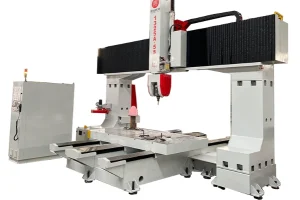
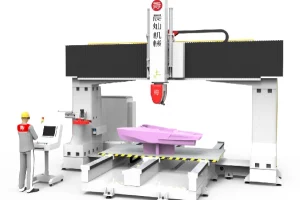
A table move structure is especially useful when workpieces are medium size, light enough for stable table movement, and still require true 3D machining. Instead of building around an oversized moving gantry, the machine uses active worktable movement with spindle linkage, which helps keep the footprint compact while supporting multi-angle cutting.
Compact Structure for Medium-Size Mold Work
The SF2513Q-5S Table Move Type 5 Axis CNC Router for Mold Making is designed for 3D machining and tight-tolerance mold work. Its stroke size is X 2500 mm, Y 1300 mm, and Z 1200 mm, with a 5 axis working size of X 2500 mm, Y 1300 mm, and Z 800 mm. For many foam molds, wood patterns, resin models, smaller marine plugs, rail interior parts, and sanitary ware molds, that range is enough without stepping into a much larger machine class.
The model also uses a table move structure with high-accuracy ball screws. That matters because lightweight workpieces do not need the same loading strategy as heavy metal blocks. If the material is light and the machining area is moderate, the factory can keep the footprint tighter while still gaining useful 5 axis capability.
Real 5 Axis Range for Curved Surfaces
The machine lists an A axis range of ±120° and a C axis range of ±360°. That gives room for angled machining, side-surface work, and continuous 3D finishing on curved parts. For mold buyers, this can reduce manual polishing, secondary positioning, and the hidden labor cost that often follows both.
Manual finishing often becomes an accepted workshop habit, but it is still a cost. A well-matched 5 axis router should remove part of that burden by finishing more geometry directly on the machine.
Which Technical Details Should Buyers Check First?
A 5 axis CNC router should never be judged by one number alone. Buyers need to review the structure, motion system, spindle package, accuracy data, workholding, and service plan together. That is the difference between buying a machine that looks advanced and one that stays useful after installation.
Structure and Motion Stability
For mold making, surface continuity matters. Small vibration marks on foam or resin may look minor at first, but after coating or finishing they can become very visible. A practical buyer check should cover:
- cast or welded structure quality
- rail support and screw drive layout
- thermal stability during long shifts
- vibration behavior during angled cutting
- repeatability after repeated toolpaths
The SF2513Q-5S lists positioning accuracy of 0.04 mm/m and repeatability of 0.025 mm/m on the X, Y, and Z axes. These figures give buyers a useful starting point for comparison, but they should still ask how the machine is inspected, calibrated, and accepted before shipment.
Spindle, Tool Change, and Cutting Rhythm
The standard configuration includes a 15 kW spindle, 24,000 rpm spindle speed, an HSK 63F spindle cone, and 8-position tool change. That combination suits many mold and pattern jobs where roughing, semi-finishing, and finishing tools all need to be used in one program.
For buyers, the key question is not “What is the highest rpm?” It is usually better to ask:
- Can the spindle cut our material for a full shift?
- Is the holder stable enough for surface finishing?
- Can the tool change setup reduce manual downtime?
- Does the supplier recommend tool paths for foam, MDF, resin, composites, or light alloys?
A small shop may not call this process planning, but that is exactly what it is. The machine has to match the real cutting rhythm of the workshop.
How Should Buyers Read CHENcan’s Manufacturing Background?
A 5 axis CNC router purchase carries risk because it is not a small bench tool. It requires design experience, machining ability, inspection, installation, and after-sales support. Buyers should judge whether the supplier controls the parts that matter after delivery, not just how the brochure looks.
In-House Processing and Inspection Matter
For industrial CNC equipment, in-house structural processing matters because the bed, gantry, moving table, and precision mounting surfaces determine the base accuracy. CHENcan’s knowledge base also references inspection tools such as coordinate measuring equipment, laser calibration equipment, laser interferometers, ballbar tools, and precision turntable systems.
A simple but effective buyer question is this: how will our machine accuracy be checked before shipment?
If the answer is vague, it is better to slow down the purchase and ask for a clearer technical acceptance plan.
Application Experience Should Guide Configuration
CHENcan’s 5 axis equipment is used across wood, composites, brittle materials, and light alloys. For this article topic, the key issue is material fit. A machine for lightweight molds should not be configured like a heavy metal cutting center. It should be matched to workpiece weight, holding method, dust control, spindle package, and operator workflow.
That is also why buyers should not copy another factory’s machine list blindly. Even two mold shops may need different tables, guarding, vacuum options, software flow, or tool sensing depending on what they actually machine every week.
img.engineered for 3D machining.webp
What Configuration Choices Reduce Trouble After Installation?
The final decision should connect technical data with daily operation. A machine can look impressive on paper and still create trouble if the table, dust system, software flow, or service plan is weak. It is much better to review those details before the deposit than after delivery.
Table, Holding, and Dust Control
The SF2513Q-5S standard worktable is an iron T-slot table, with aluminum table and vacuum table options available. For lightweight workpieces, that choice matters because the right holding method affects both machining stability and daily setup speed.
T-slot holding suits fixtures, blocks, and parts that need mechanical clamping. A vacuum table suits thinner sheet-style or lighter parts with enough surface area for stable suction. Dust collection is worth discussing early as well, because foam, MDF, resin, and composite dust can quickly contaminate the work area and machine components.
Service, Training, and Long Use
Before buying, review the service support scope, not just the machine body. The project should cover technical confirmation, installation guidance, commissioning, operator training, and a clear contact path for later questions. CHENcan also states that it supports on-site engineer service, installation guidance, commissioning, and training for the SF2513Q-5S project.
For buyers still comparing machine types, the solution page is a useful place to match materials and industries before asking for a quote. The best inquiry is not just “send price.” It should include part drawings, material, size, finish requirements, expected output, and available floor area so the supplier can recommend a machine that fits the work instead of only fitting a catalog page.
FAQ
Q1: Is a table move 5 axis CNC router suitable for all lightweight workpieces? A: No. It is a strong option when the workpiece is medium size, relatively light, and needs 3D machining or angled cutting. If the part is very long or too heavy for table movement, another structure may be better.
Q2: Why should I choose a 5 axis CNC router instead of a 3 axis machine? A: A 3 axis machine can handle flat cutting and simple contour work. A 5 axis router is better when the part has curved surfaces, side machining, angled trimming, or mold features that would otherwise require manual finishing or repeated setup.
Q3: What makes the SF2513Q-5S fit smaller workshops? A: It uses a table move structure and a 2500 mm by 1300 mm working range for 5 axis machining, helping buyers gain useful 3D capability without stepping into a much larger floor-space footprint.
Q4: What information should I send before asking for a quote? A: Send the material type, part size, thickness, 3D model or drawings, surface finish requirements, holding method, daily output target, and available floor space. These details help the supplier recommend the right table, spindle, tooling, and guarding.
Q5: How can I reduce risk before placing an order? A: Ask for technical confirmation, sample processing where possible, accuracy inspection details, machine layout drawings, service terms, installation support, and training scope before you commit to the order.