RV and cold-chain builders should choose a sandwich panel cutting machine by testing their real panel stack, not by comparing spindle power or travel speed in isolation. A useful procurement trial must reproduce the production part: skins, adhesive, core, protective film, thickness, openings, edge profiles, fastening details, and the actual hold-down method. The machine should pass defined checks for both-face edge quality, core damage, dimensions, repeatability, dust removal, cycle flow, and the condition of the panel after it is released from the table.
This approach separates a production-capable system from a machine that makes one attractive demonstration cut. It also creates a defensible choice between three-axis routing and multi-process five-axis sawing and milling without repeating a generic feature comparison.

Build the Trial Around the Actual Panel Stack
A sandwich panel is several materials working together. An FRP, aluminum, coated steel, or other face sheet may sit over an adhesive line and a foam, honeycomb, mineral, or wood-based core. Each layer can respond differently to cutting force, heat, tool exit, suction, and vibration. A clean top face does not prove that the lower skin, adhesive line, and core are intact.
Bring the proposed supplier full-size production panels from normal incoming stock. Include the thickest and thinnest constructions, difficult surface films, embedded frames or reinforcements, and any panel with a different skin material. If panels arrive with normal thickness or flatness variation, the trial should not quietly replace them with unusually perfect samples.
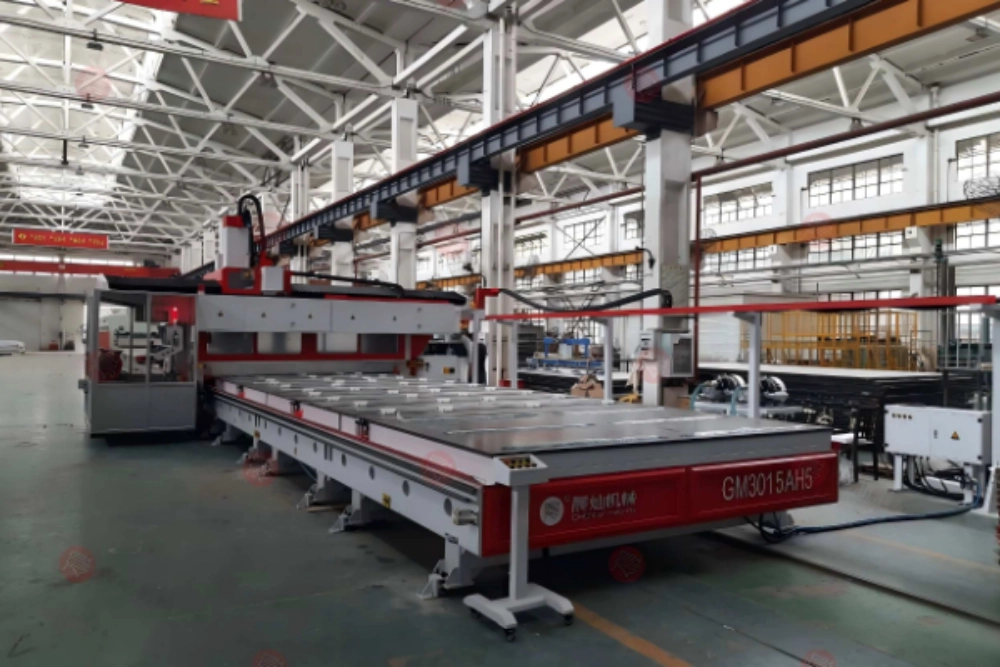
Die CHENcan panel CNC cutting machine range is designed around large isothermal and sandwich panels used in reefer bodies, motor homes, mobile cabins, and related structures. The model still has to be proven against the buyer’s own material combinations.
Define Pass and Fail Before Cutting
Write the acceptance sheet before the demonstration starts. Otherwise, the team will tend to judge the best-looking sample after the fact. Assign a measurement method and a pass limit to every critical feature.
The trial should cover at least these outputs:
- edge condition on the upper and lower skins;
- exposed-core tearing, melting, compression, or pullout;
- hole and opening position relative to assembly datums;
- straightness and bevel geometry on joining edges;
- repeatability across more than one panel and more than one table position;
- panel dimensions after vacuum is released;
- dust left in the cut, on the table, and around the enclosure;
- time for loading, datum setting, cutting, unloading, and cleaning.
The published configurations in the CHENcan panel CNC cutting machine range lead to the same practical conclusion: acceptance should follow the complete part, not one visible edge.
Verify Hold-Down as the Nest Changes
Large panels can be light, flexible, or slightly bowed. Vacuum may appear strong at the beginning of a cycle, then change as window, door, vent, or service openings reduce the sealed area. Small parts inside a nested sheet may also lose support before the outer profile is complete.
Ask the supplier to run the real cutting order. Watch for movement during internal openings, corner finishing, and the last cut that releases a part. Check whether vacuum zones can be isolated, whether the spoilboard or support surface stays flat, and how through-cuts affect suction. Record dimensions again after the panel leaves the table; a part held flat by vacuum can relax into a different shape.
For high-volume flat work, the CHENcan three-axis sandwich panel cutting machine provides a relevant baseline. Its suitability depends on whether vertical routing, drilling, and profiling complete the buyer’s part without repeated manual repositioning.
Choose Axes From Features, Not From Prestige
Five-axis motion is not automatically better for every RV wall or refrigerated body panel. If production consists mainly of flat profiles and vertical openings, a three-axis route may be simpler to program, operate, and maintain. The decision changes when the assembly requires bevels, angled joints, compound edge preparation, or saw access that cannot be produced efficiently with a vertical spindle.
Die CHENcan multi-functional five-axis panel cutting machine combines a spindle, multi-axis saw functions, a hollow vacuum table, and a mobile cabin. The procurement question is whether those functions remove separate operations from the buyer’s real workflow. Request a demonstration that drills, mills, saws, bevels, and finishes one representative panel without substituting manual work between steps.
Test the Saw and Spindle as Separate Processes
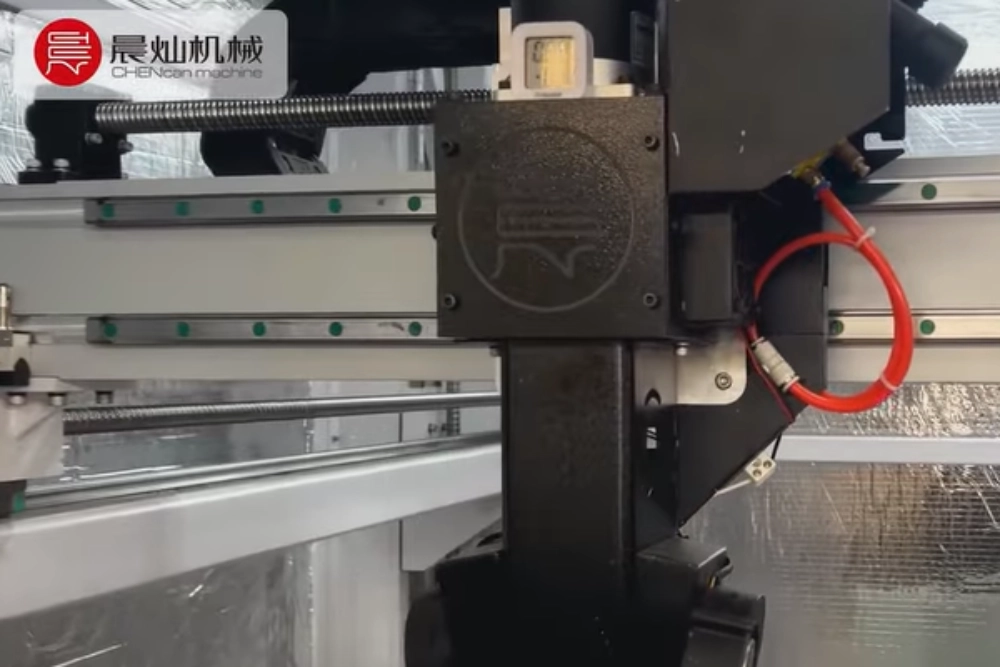
A saw and a router do different work. The saw may be efficient for deep straight cuts or certain thick panel sections, while the spindle handles pockets, holes, slots, contours, and local finishing. Their value depends on tool access, skin and core behavior, cut direction, and the required joint.
Run the same critical edge with candidate tools where practical. Inspect burrs, delamination, crushed core, heat marks, breakout, and protective-film lifting. Then assemble a sample joint with the real sealant, adhesive, extrusion, or fastener. The CHENcan five-axis sandwich panel cutting configuration shows why saw and spindle access must be evaluated against the real joint: a visually neat edge still has to support sealing and assembly.
Tool choice should be written into the process record with diameter, geometry, cutting direction, speed, feed, depth strategy, expected life, and replacement criteria. A machine trial that uses a special new tool but does not disclose it is not a repeatable production trial.
Treat Dust Control as Part of the Cutting Process
Panel machining may produce dust, chips, fibers, and small core fragments. These can obstruct the support surface, reduce vacuum sealing, contaminate components, hide defects, and increase cleaning time. Dust control therefore affects both safety and process stability.
Ask for the airflow and extraction arrangement proposed for the exact tool and material. Observe where waste travels during through-cuts, whether the hood stays effective as axes rotate, how the hollow table handles debris, and how filters and collection containers are serviced. The OSHA woodworking health-hazard guide is a useful starting reference for exposure controls, but the final extraction design and compliance assessment must reflect the actual panel materials and local regulations.
Do not accept a tidy machine after the supplier has paused to clean between operations. Measure the production sequence, including the time and labor required to keep the table, enclosure, tooling, and work area in a controlled state.
Check the Entire Production Flow
Travel size should include more than nominal panel dimensions. Allow for datum stops, tool clearance, loading access, clamps or vacuum zones, trim allowance, and safe operator movement. Then map the part flow before and after cutting: incoming panels, protective-film handling, program release, labeling, stacking, sealing, and delivery to assembly.
A longer bed is valuable only if the factory can load it safely and if the control, extraction, and workholding remain effective over the full area. Likewise, automatic tool change helps only when the tool list, calibration routine, and program structure are ready for production. Ask who owns post-processing, how programs are released, and how revisions are prevented from reaching the wrong panel.
Maintenance access belongs in the same review. Inspect filter replacement, vacuum-pump service, saw and spindle access, lubrication, calibration, electrical cabinet protection, and the space needed to remove major components. A compact quotation drawing may not show the service envelope.
Use a Repeatable Acceptance Matrix
| Acceptance item | Trial method | Evidence to retain |
| Material response | Cut every production skin-core combination | Photos of both faces, exposed core, and joint sample |
| Dimensional control | Measure features at multiple table positions | Inspection report before and after vacuum release |
| Workholding | Complete openings and release cuts in production order | Vacuum-zone settings and movement observations |
| Process coverage | Run drilling, routing, sawing, and beveling as required | Program, tool list, and operator intervention log |
| Dust management | Run a full cycle without staged cleanup | Extraction settings, cleanup time, and residue record |
| Repeatability | Produce several consecutive parts | Dimensions, edge findings, cycle times, and tool condition |
The matrix should be attached to the purchase specification. It gives production, quality, maintenance, and management teams the same definition of success and makes later factory acceptance testing easier to plan.
Match the Machine to the Parts You Intend to Sell
Before requesting a final configuration, send the supplier panel drawings, annual product mix, largest panel, material stack list, required edges and openings, cycle target, inspection method, dust constraints, and plant layout. Include future parts only when they are backed by a realistic sales or engineering plan; buying every possible axis and option can add complexity without improving the current process.
Use the CHENcan technical contact channel to arrange a trial around the hardest representative panel. The most useful quotation will state which operations the proposed sandwich panel cutting machine completes, which remain manual, what utilities and extraction are required, and how acceptance will be measured.
FAQ (häufig gestellte Fragen)
Q1: Is a five-axis machine always necessary for RV panels?
A: No. Flat profiles and vertical openings may be handled efficiently on three axes. Five-axis capability earns its place when angled cuts, bevels, complex edge preparation, or multi-process sawing remove separate operations.
Q2: Why must both panel faces be inspected?
A: The upper skin can look clean while the lower skin shows breakout or the core is torn, melted, or compressed. Those hidden defects can affect sealing and assembly.
Q3: What panel should be used for the supplier trial?
A: Use normal production stock, including the most difficult skin-core combination, real thickness, protective film, embedded features, and representative openings and edges.
Q4: How many parts should an acceptance test include?
A: More than one. Consecutive parts and different table positions reveal changes in hold-down, tooling, extraction, and repeatability that a single demonstration cannot show.
Q5: What evidence should the buyer keep?
A: Retain the program revision, tool list, process settings, inspection report, photos of both faces and the core, cycle log, cleanup time, and notes on operator intervention.