
For most large mold projects, 15 kW is a sound starting point for foam, soft modeling board, and finishing. A range of 18.5 to 24 kW gives more room for dense resin, epoxy tooling board, larger cutters, and mixed roughing work. Power from 30 to 42 kW becomes useful when production requires wide tools, heavy stock removal, or long continuous cycles.
These are practical ranges, not fixed rules. The final choice also depends on torque, rpm, cutter size, tool extension, machine rigidity, and daily running time.
What Does Spindle Power Really Change?
Spindle power affects how much cutting load the machine can carry without losing speed. One large mold may need roughing, long-reach cutting, steep-wall machining, and fine finishing.
Power and Torque Are Different
Power describes the rate of work, while torque describes rotational force. A spindle may reach quoted power at high rpm but provide less torque at the lower speed used by a large cutter. Buyers should request the full power and torque curve and ask whether the listed kW is continuous or peak output.
More Power Raises the Possible Removal Rate
A stronger spindle can support a larger cutter, deeper engagement, or faster feed. This helps when a foam or resin blank contains a large stock allowance. Yet spindle power cannot correct a flexible rotary head, weak tool holding, poor dust removal, or an unstable workpiece.
Surface Finish Needs Stability
Fine mold surfaces depend on spindle runout, tool balance, feed per tooth, toolpath, and machine stiffness. Extra kW does not remove chatter. For a boat plug or blade mold, a stable 15 or 24 kW spindle may leave a cleaner surface than a heavier spindle that does not suit the head structure.
Which Power Range Fits Each Mold Material?
Material names are only the first clue. Foam density varies, resin boards may contain mineral filler, and FRP can mean thin trimming or thick abrasive laminate. The regular production load should set the specification, not one rare job.
When Is 15 kW Enough for Foam?
A 15 kW high-speed spindle often suits EPS, polyurethane foam, soft modeling board, casting patterns, sculpture forms, and finishing work. Foam creates low cutting force, so output usually depends more on rpm, feed, sharp tools, and dust collection.
The main limits appear with wide cutters, deep engagement, or long tools that begin to vibrate. In these cases, stiffness and tooling may matter as much as motor size.
When Should Resin Work Move to 18.5 or 24 kW?
Dense resin, epoxy board, putty, and filled tooling materials create higher loads. An 18.5 to 24 kW spindle gives useful reserve for larger tools and long roughing cycles. It is often the balanced range for factories that alternate between soft patterns and harder mold materials.
This range fits mixed production where cycle time matters.
Does FRP Always Need High Power?
No. Thin FRP trimming and drilling may use modest power. Cutter geometry, dust extraction, tool wear, and part support often matter more. Glass reinforcement is abrasive, and a worn cutter raises heat and spindle load even during a shallow cut.
For thick composite tooling, broad cutter engagement, or heavy edge machining, 24 to 30 kW offers more working room. Power from 30 to 42 kW should be selected only after a cutting trial proves the benefit.
When Is a 42 kW Spindle Worth the Cost?
A 42 kW spindle can make sense when large cutters remove heavy stock for several hours, when one machine must process foam, resin, FRP, wood substitutes, and light alloys, or when a shorter roughing cycle directly releases production capacity.
It also adds electrical demand, cooling load, head weight, and purchase cost. Buyers should compare removal rate, tool life, spindle load, and total cycle time.
How Does the 11-Meter Five-Axis Machine Fit These Jobs?
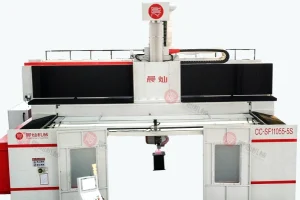
Die 11meter Large Scale 5 Axis Machining Center for Molds lists a 15 kW, 24,000 rpm spindle as standard, with optional power up to 42 kW. Its stroke is 11,000 × 5,500 × 2,200 mm, while the five-axis working range reaches 10,000 × 4,500 × 1,800 mm. The A axis moves ±120°, the C axis rotates ±360°, and the tool changer holds 10 tools.
The no-table structure leaves room for oversized molds and custom fixtures. The X axis uses rack-and-pinion drive for long travel, while the Y and Z axes use precision ball screws. Listed materials include foam, epoxy, putty, resin, composites, wood, and light alloys. The machine weighs about 30 tonnes, so spindle choice is supported by a substantial overall structure rather than treated as a stand-alone upgrade.
A foam-focused buyer may keep the 15 kW spindle and spend more on cutters, probing, fixtures, or dust collection. Resin-heavy production may favor 24 kW. Aggressive multi-material roughing should be tested with the 30 to 42 kW options.
What Data Should Be Sent before a Quotation?
A description such as “large FRP mold” is too broad. A useful spindle proposal needs:
- Material type, density, filler, and reinforcement
- Raw size, finished size, and stock allowance
- Largest cutter diameter and longest tool extension
- Roughing depth, stepover, feed, and rpm
- Required tolerance and surface finish
- Daily operating hours and longest continuous cycle
- Dust collection, cooling, and factory power conditions
- Materials expected within the next three to five years
CHENcan provides large-format CNC solutions for foam, polyurethane, epoxy, resin, GRC, FRC, FRP, wood, and light alloys. A workpiece trial can show spindle load, tool wear, surface quality, and actual cycle time before the final configuration is signed.
Why Does Supplier Experience Matter?
Spindle selection affects the rotary head, electrical system, cooling, tool interface, dust control, and machine dynamics. It should not be reduced to one number on a quotation.
CHENcan kann was founded in 1998. It provides service to more than 12,000 companies in over 70 countries and regions. It also has two production and research bases, more than 270 employees, over 10% R&D staffing, and in-house machining of structural parts. It also records ISO 9001 and CE certification for the production bases.
The company developed high-speed equipment for foam and wooden casting molds in 2011, followed by a large composite five-axis center with RTCP in 2014. In 2023, it completed a 65-meter-travel machine for wind turbine blade molds.
Buyers can review the company background, discuss installation and training with the service team, or contact the technical team with drawings and material data. Service coverage includes installation, operation training, maintenance training, programming, repair, and technical troubleshooting.
Which Spindle Power Should Be Chosen?
Choose 15 kW for mainly foam and finish-focused work. Choose 18.5 to 24 kW for dense resin, epoxy, putty, and mixed production. Consider 24 to 30 kW for thicker FRP or composite cutting with larger tools. Choose 30 to 42 kW only when trial results show that heavy removal or long cycles will repay the added cost.
The final check should use the planned cutter and real material. Record spindle load, rpm stability, feed, surface finish, tool wear, and cycle time. A short test costs far less than years of running the wrong spindle.
FAQ (häufig gestellte Fragen)
Q1: Is 15 kW Enough for a Large Foam Mold?
A: In many cases, yes. Foam has low cutting resistance, so 15 kW at high speed can support large patterns and finishing. Tool length, cutter diameter, feed, and dust removal still need checking.
Q2: Does FRP Machining Require a 42 kW Spindle?
A: Usually not. Thin trimming and drilling may run well at lower power. A 42 kW option is better suited to thick sections, wide cutters, heavy engagement, or long roughing cycles.
Q3: Is Spindle Speed More Important than Power for Foam?
A: Often, yes. High rpm and correct feed per tooth help a sharp cutter move cleanly through foam. Power becomes more important as cutter diameter and material density rise.
Q4: Why Should Buyers Check the Torque Curve?
A: Maximum power may only be available within a certain rpm range. The torque curve shows whether the spindle can hold cutting force at the speed used by the tool.
Q5: Can One Spindle Handle Foam, Resin, and FRP?
A: Yes, when power, torque, tool holding, cooling, and machine structure match the material mix. The 11-meter machine offers spindle choices from 15 to 42 kW for different production loads.


