Cleaner sandwich panel edges matter because the cut becomes part of the final joint. In refrigerated bodies, cold rooms, and modular vehicles, poor edge quality can create gaps, uneven sealant thickness, thermal bridges, water entry, and extra fitting work. Cleaner sandwich panel edges therefore influence both appearance and field performance.
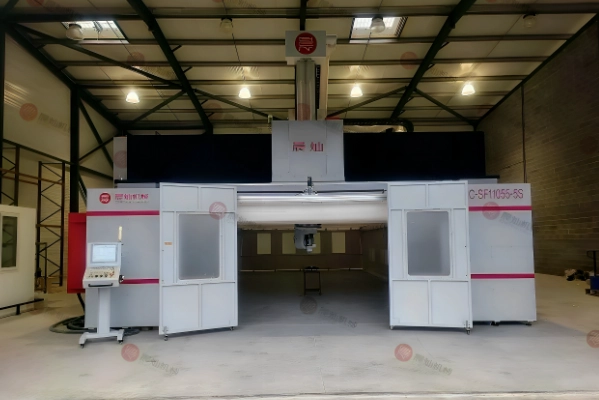
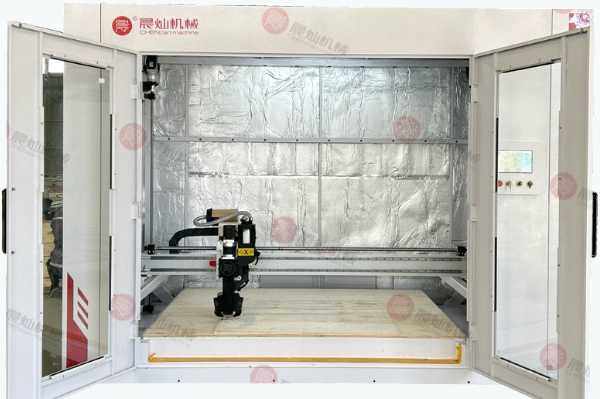
El 5 Axis CNC Panel Cutting Machine for Sandwich Panel from CHENcan is designed for shaped cuts, openings, bevels, and edge preparation that cannot be completed efficiently with flat two-dimensional cutting alone. Five-axis movement is most valuable when cleaner sandwich panel edges, accurate assembly geometry, and repeatable production must all be achieved in one machining cycle.
How Do Poor Edges Become Cold Chain Problems?
A panel joint must control heat transfer, moisture, and mechanical movement. If the skin is burred, the core is torn, or the bevel angle varies, profiles and sealants cannot seat evenly. Installers may compensate by trimming by hand or adding more sealant, but the correction is inconsistent and hard to inspect.
In refrigerated vehicles, vibration and repeated door cycles can enlarge a weak joint. In cold rooms, condensation can form where insulation continuity is interrupted. For modular cabins, visible defects around windows, vents, and service openings also reduce finish quality. Cleaner sandwich panel edges help avoid these downstream problems before assembly starts.
Why Does Five-Axis Cutting Improve Panel Preparation?
Bevels and Compound Angles in One Setup
Five-axis movement allows the cutting head to approach the panel at a controlled angle. This is useful for mitred corners, sloped roof joints, curved body sections, and profiles that need a prepared sealing face. Fewer manual transfers reduce the chance of losing the datum between operations and make cleaner sandwich panel edges more repeatable.
Cleaner Openings for Doors, Windows, and Equipment
Cold chain panels often need openings for evaporators, drains, lighting, door frames, vents, and wiring. The machine can cut the outline and prepare edge geometry directly from the programmed model. Consistent opening quality reduces onsite trimming and makes reinforcement parts easier to position correctly.
Repeatability Across Kits and Vehicle Sets
A modular room or refrigerated body is assembled from a coordinated set of panels. When each panel is cut from the same digital data, matching holes, corner lines, and edge angles remain consistent across the kit. Cleaner sandwich panel edges become especially important in batch production and in replacement panels that must fit later without rework.
Less Manual Contact With Composite Cores
Hand routers and saws can crush soft cores or delaminate skins if they are not well controlled. A stable CNC process limits repeated handling and gives the operator a defined feed path. The correct tool and extraction system are still essential because different cores create different chips, heat, and edge behavior.
Which Panel Variables Change the Cutting Strategy?
| Panel Variable | Possible Cutting Issue | Process Response |
| Skin material | Burrs, heat, coating damage | Select suitable tool geometry and feed |
| Core type | Tearing, melting, dust, compression | Adjust tool, speed, support, and extraction |
| Panel thickness | Tool reach and edge deflection | Check clearance and use stable workholding |
| Surface protection film | Lifting or wrapping around tool | Plan cutting direction and film condition |
| Required joint | Bevel angle or profile mismatch | Program edge geometry from assembly design |
Polyurethane, PIR, rock wool, honeycomb, and other core structures do not cut in the same way. Before locking a production parameter, the processor should test the actual skin-core combination and inspect both faces, the exposed core, and the final dimensions. Cleaner sandwich panel edges should be verified on real assemblies, not assumed from a clean-looking cut alone.
How Should Workholding and Dust Control Be Planned?
Large panels must remain flat without being crushed. Vacuum zones, supports, stops, and sacrificial layers should match common panel sizes and leave space for through-cuts. If the sheet bridges across unsupported areas, tool pressure can move the panel and change the edge angle.
Dust control should be designed for the actual core. Fine mineral fibers, foam chips, and metal or composite skin particles require different collection and filtration strategies. Extraction close to the cutting head improves visibility and reduces accumulation around drives and sensors, which helps keep cleaner sandwich panel edges stable over longer production runs.
What Quality Checks Should Be Made at the Machine?
- Measure opening dimensions and diagonal squareness before removing the panel.
- Check bevel angle at several points, not only at the start of the cut.
- Inspect both skins for burrs, coating damage, and delamination.
- Check the exposed core for tearing, voids, melting, or compression.
- Assemble a representative corner or frame profile to verify real joint fit.
- Record tool life and edge quality so parameters can be maintained across batches.
How Does Edge Quality Affect Installation Cost?
Cleaner factory-cut edges reduce manual trimming, sealant correction, and time spent aligning profiles. This is especially valuable when vehicle bodies or modular rooms are assembled in another country, where field rework is expensive and replacement panels take time to ship. In practice, cleaner sandwich panel edges reduce both labor variability and installation risk.
The benefit should be measured at assembly, not only at the CNC table. Track fitting time per panel, sealant consumption, rejected openings, water-leak tests, and corrective labor. These metrics show whether the new cutting process is improving the finished product.
What Should Buyers Confirm Before Selecting a Machine?
Share maximum panel dimensions, thickness range, skin materials, core types, required bevel angles, opening geometry, target output, and dust conditions. Provide CAD files for the most difficult parts instead of only simple rectangles. The machine supplier can then check travel, head orientation, tool access, and fixture design against real production work.
Review related CHENcan applications and define an acceptance test that includes the actual panel stack. A clean visual cut is useful, but successful assembly, sealing, and dimensional fit should be the final standard for cleaner sandwich panel edges.
Conclusion
Cleaner sandwich panel edges protect insulation continuity, joint accuracy, and assembly efficiency. Five-axis CNC cutting is valuable when panels require bevels, complex openings, or coordinated geometry that would otherwise need several manual operations. For cold chain and vehicle builders, cleaner sandwich panel edges directly support more predictable installation quality.
The right machine should be evaluated through finished panel kits and representative joints. That connects cutting performance directly to cold chain reliability, assembly speed, and modular vehicle build quality.
Preguntas frecuentes
Why Is a Bevel Angle Important on Sandwich Panels?
The bevel determines how adjacent panels, corner profiles, or sealant faces meet. Angle variation creates gaps and uneven compression in the joint.
Can One Tool Cut Every Sandwich Panel Core?
Usually not. Foam, mineral wool, honeycomb, and composite cores have different cutting behavior. Tool geometry and process parameters should be tested for each construction.
Does Five-Axis Cutting Remove the Need for Fixtures?
No. Accurate angular cutting still requires the panel to remain flat and stable. Poor support can change the cut even when axis positioning is correct.
What Is the Best Way to Verify Edge Quality?
Measure dimensions and angle, inspect both skins and the core, and assemble a real corner or profile. Joint fit reveals defects that may not be obvious on a loose panel.
Can CNC Cutting Reduce Onsite Rework?
Yes, when openings, bevels, and kit geometry are produced accurately from approved files. The reduction should be tracked through assembly time and corrective labor.