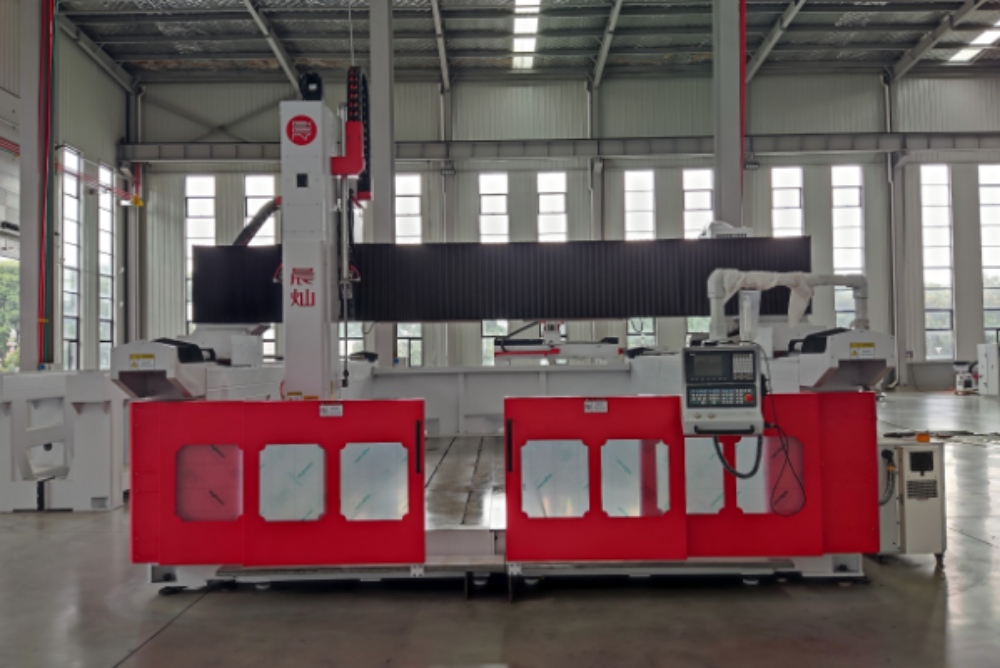
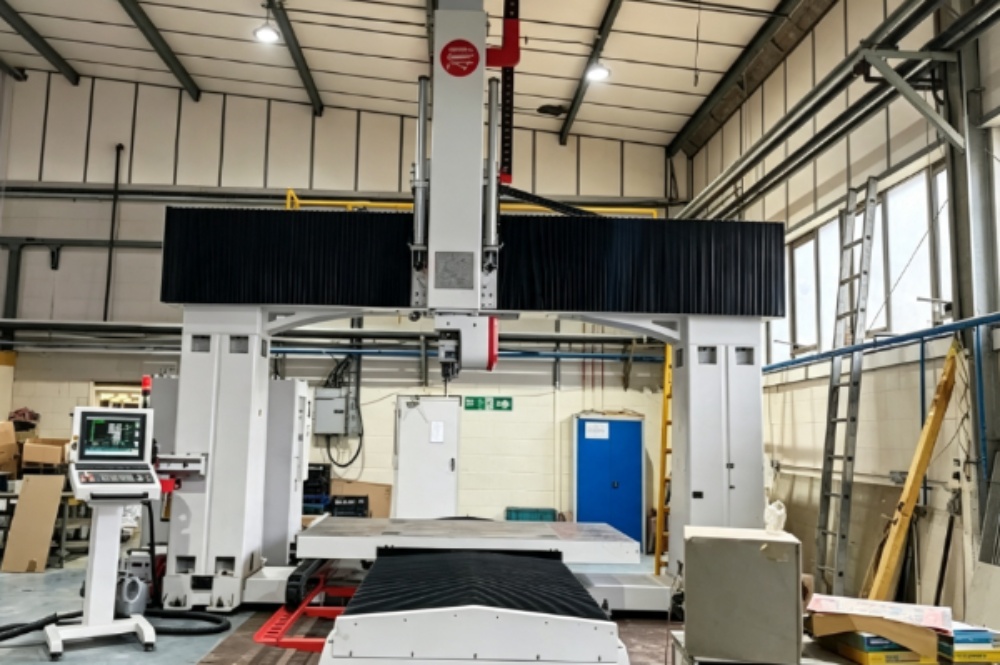
Curved surfaces, inclined holes, deep cavities, and changing draft angles create a familiar production problem. A conventional three-axis machine can often reach these features, but it may need several fixtures and repeated repositioning. Every extra setup introduces another chance for datum shift, clamping distortion, probe error, or operator variation.
5-axis CNC machining reduces that risk by changing tool orientation while the program is running. The cutter can approach several faces without removing the workpiece from its original fixture, so fewer setups usually mean fewer accumulated errors, shorter lead times, and smoother transitions between adjoining features.
This matters in automotive molds, marine tooling, aerospace components, sanitary products, architectural forms, and large artistic models. On these parts, a small mismatch between two setups can leave a visible step that later consumes hours of hand finishing.
Why Do Multiple Setups Create Accuracy Problems?
A setup error rarely comes from one dramatic mistake. In most shops, several small deviations build on each other. The fixture sits slightly differently, a reference face carries dust, or a long tool bends during a deep cut. The finished part may still look acceptable at first glance, but inspection shows that holes, surfaces, or trim lines no longer share the same coordinate relationship.
Datum Errors Build Up after Repositioning
Three-axis machining normally keeps the cutter vertical. When a part includes side walls, inclined holes, or undercut areas, the operator may need to rotate and clamp it again before the next operation.
Each repositioning requires:
- A new work offset
- Another alignment check
- Fresh fixture pressure
- Additional probing or manual measurement
- A second chance for chips to sit under the workpiece
Even a small shift becomes expensive on a large mold. A 0.2 mm step along a long body-panel tool can trigger sanding, measurement, and surface repair after the machine cycle is finished.
Long Tools Add Deflection and Surface Marks
A fixed vertical spindle often needs a long cutter to reach a sloped wall or deep pocket. The extra length reduces stiffness, so chatter, deflection, and uneven cutting pressure become more likely, especially near corners and transitions.
5-axis CNC machining lets the spindle tilt toward the feature, so a shorter tool can often reach the same surface. Better rigidity improves both dimensional control and surface quality.
How Does Five-Axis Motion Keep Features in One Coordinate System?
A five-axis machine combines three linear axes with two rotary axes. The tool moves along X, Y, and Z while rotating around the A and C axes, allowing the workpiece to stay fixed as the cutter approaches curved or inclined areas from multiple directions.
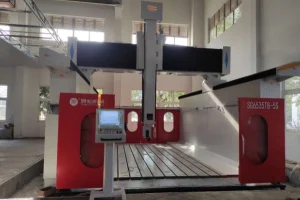
The SF2640A-5S High Speed 5 Axis CNC Machine for Mold Making uses an A-axis range of ±120° and a C-axis range of ±360°. This kinematic range supports spherical surfaces, irregular curves, inclined holes, cavities, and multi-face mold features in one machining cycle.
One Clamping Preserves Feature Relationships
When the part stays in one fixture, its holes, pockets, contours, and reference faces remain tied to the same datum. 5-axis CNC machining changes tool orientation instead of asking the operator to change part orientation.
This approach helps reduce:
- Misalignment between adjoining surfaces
- Position errors between holes and contours
- Fixture-to-fixture variation
- Repeated inspection between operations
- Manual blending after machining
Single-setup production does not remove every error source. Tool length, machine calibration, fixture stiffness, programming quality, and post-processing still matter. What it removes is one of the least predictable variables, which is repeated manual handling.
RTCP Keeps the Tool Tip on the Programmed Path
RTCP means rotational tool center point control. When the rotary head changes angle, the control system coordinates all five axes so the cutter tip remains on the programmed path.
Without RTCP, tilting the head would move the tool tip away from the target point. With RTCP, 5-axis CNC machining can compensate for that movement in real time, which is critical on smooth curves, steep walls, and surfaces where the tool angle changes continuously.
CHENcan began developing large composite five-axis equipment with RTCP capability in 2012 and completed its first major system in 2014. The company also developed its own bi-rotary head technology and introduced laser calibration tools for installation and accuracy checks.
Which Machine Features Support Stable Five-Axis Cutting?
Axis count alone does not guarantee an accurate part. A machine also needs a rigid frame, low-backlash transmission, stable rotary motion, suitable workholding, and enough spindle speed for the target material. Buyers should evaluate the complete structure rather than treating 5-axis CNC machining as the whole specification.
The SF2640A-5S belongs to the gantry-moving SF series and was developed for mold production in automotive, aerospace, marine, railway, sanitary, composite, and artistic applications. Typical materials include wood, foam, PVC, composites, epoxy, putty, resin, fiber-reinforced materials, and selected light alloys.
Ball Screws and a Heavy Structure Limit Motion Error
The machine uses high-precision ball screws on the X, Y, and Z axes. Its heavy-duty structure is intended to maintain rigidity during long machining cycles, where vibration and thermal movement could otherwise affect the surface.
Key standard specifications include:
- Axis strokes of 4000 × 2600 × 2000 mm
- Five-axis working area of 3000 × 1600 × 1600 mm
- 15 kW spindle
- Maximum spindle speed of 24,000 rpm
- Eight-position tool changer
- Maximum rapid speeds of 60, 60, and 20 m/min
- Positioning accuracy of 0.04 mm/m
- Repeatability of 0.025 mm/m
- Vacuum table with T-slots
The self-developed rotary head combines high rotational speed, torque, reduction gearing, and pneumatic braking. That design helps the head hold its angle during extended cutting and supports more stable 5-axis CNC machining on complex surfaces.
Tool Angle Affects Both Accuracy and Finish
On a curved mold, the cutting point moves across the cutter as the surface angle changes. Poor orientation can push the tool near its center, where cutting speed is less effective and tool pressure becomes less even.
Continuous 5-axis CNC machining lets the program hold a better contact angle. The result can be smoother finish, shorter tools, steadier cutting loads, and less polishing after machining.
There is an important practical point here. Higher spindle speed does not automatically create a better surface. Cutter type, stepover, feed rate, material density, and tool orientation still need to work together, and final parameters should come from a real cutting test.
What Should Buyers Verify before Ordering a Five-Axis Machine?
A brochure cannot show how 5-axis CNC machining will perform on a specific mold material, cavity depth, or surface tolerance. The safest buying process starts with drawings, material samples, expected annual output, and a list of difficult features.
CHENcan has operated since 1998 and reports two production and research bases covering more than 60,000 square meters. Its has more than 270 employees, over 10% of staff in R&D, and more than 130 invention and utility-model patent applications by the end of 2022. Structural parts are processed in-house, while the production bases carry ISO 9001 and CE certification.
Request a Test with the Hardest Features
A useful cutting trial should not rely on a flat sample only. It should include the features most likely to cause trouble:
- A steep curved wall
- An inclined hole
- A deep pocket
- A narrow transition
- A long finishing path
- Two features that must share one datum
The test should record cycle time, surface finish, dimensional results, tool length, fixture method, and the amount of manual finishing left afterward.
The technical support records supplied by CHENcan include more than 1,000 process solutions and over 100 workpiece trial-processing services per year. Buyers can review suitable configurations through its five-axis CNC solutions before confirming spindle power, table type, dust collection, enclosure, cameras, probes, or tool measurement options.
Check Calibration and Long-Term Service
Long-term accuracy depends on regular calibration. Daily cleaning, lubrication checks, tool inspection, pressure checks, and periodic geometric calibration help keep the rotary center and linear axes working together.
The CHENcan service team supports installation, operation training, maintenance training, CNC programming, troubleshooting, repair, and refurbishment. The company’s knowledge base also records nearly 40 professional service technicians, a one-to-two-year warranty depending on the model, and lifetime technical support.
How Can Manufacturers Reduce Setup Errors in Real Production?
5-axis CNC machining reduces setup errors mainly by keeping curved and inclined features in one fixture and one coordinate system. Rotary tool motion reaches multiple faces without repeated manual repositioning, which makes the process more repeatable from part to part.
The strongest results come from combining 5-axis CNC machining with:
- A rigid machine structure
- Accurate rotary calibration
- Short and suitable cutting tools
- Stable fixtures
- Correct post-processing
- Collision checking
- Real workpiece trials
- Scheduled maintenance
For molds and other shaped parts, the benefit is not only a faster cycle. Less alignment work, fewer surface steps, and lower hand-finishing time often create just as much value. Project drawings and material details can be submitted through the CHENcan contact team for a machine and process review.
FAQ
Q1: Can 5-Axis CNC Machining Remove All Setup Errors?
A: No. 5-axis CNC machining greatly reduces errors caused by repeated repositioning, but accurate fixtures, calibration, programming, tooling, and machine maintenance are still required.
Q2: What Features Benefit Most from 5-Axis CNC Machining?
A: Curved surfaces, inclined holes, deep cavities, steep walls, multi-face features, and complex transitions gain the most because tool orientation can stay controlled through the cut.
Q3: What Materials Can the SF2640A-5S Process?
A: The machine is intended for wood, foam, PVC, resin, epoxy, putty, composites, fiber-reinforced materials, mold boards, and selected light alloys.
Q4: Why Is RTCP Important on a Five-Axis Machine?
A: RTCP coordinates the linear and rotary axes so the cutter tip stays on the programmed path while the spindle head changes angle.
Q5: Should a Buyer Request a Workpiece Trial?
A: Yes. CHENcan can test customer drawings and materials so the buyer can review accuracy, finish, cycle time, tooling, workholding, and remaining manual work before ordering.