
Material drying directly affects extrusion stability, layer bonding, dimensional accuracy, and the surface left on a printed mold. Wet pellets may still pass through the screw and nozzle, but that does not mean the material is processing correctly. Small amounts of retained moisture can become vapor inside the hot extrusion system. In moisture-sensitive polymers, water may also break polymer chains during heating.
The result is rarely one dramatic failure. More often, the operator sees pinholes, inconsistent bead width, weak layer interfaces, rough patches, or an extrusion rate that slowly changes during a long print. On a small test piece, those defects may look manageable. On a mold that runs for two days, they become expensive.
Why Does Moisture Change a Pellet Print?
Pellet extrusion depends on a steady melt. The screw must receive material with predictable bulk density, viscosity, and temperature response. When moisture changes those conditions, the printer cannot deposit each layer in the same way.
This matters even more in large-format mold printing. Thick beads cool slowly, the toolpath may continue for many hours, and one weak region can later crack during lifting, machining, coating, or use.
Steam Creates Bubbles and Internal Voids
Water expands rapidly when wet pellets enter a hot barrel. The released vapor may form small bubbles inside the extrudate. Some break at the bead surface and leave pinholes. Others remain inside the wall.
These voids reduce the real contact area between layers. They can also appear during CNC finishing when a cutter opens a hidden pocket below the printed skin. The mold may look acceptable before machining, then reveal a line of holes halfway through the finishing pass. It happens.
Hydrolysis Can Reduce Polymer Strength
With moisture-sensitive materials, the problem goes beyond trapped steam. Water can react with polymer chains at processing temperature. This hydrolysis lowers molecular weight and changes melt behavior. Research on polyamide and polyester processing shows why pre-drying is commonly used before high-temperature extrusion.
A degraded melt may flow more easily, which sometimes looks helpful at first. Yet the printed part may lose strength, toughness, or resistance to cracking. Adding more wall thickness cannot fully correct damaged material.
Unstable Flow Leaves a Rougher Surface
A wet material may hiss or pop at the nozzle. The deposited bead can become wider, narrower, or slightly foamed. Even when the printer completes the job, the surface may show:
- Tiny pits or silver-looking marks
- Uneven layer edges
- Local swelling
- Poor corner definition
- Visible changes after a material refill
- Rough sections that require extra machining allowance
Surface quality also depends on layer height, print speed, nozzle diameter, temperature, and toolpath. Moisture is not the only cause. It is simply one variable that should be removed before those settings are judged. Studies of material-extrusion surfaces confirm that material condition and process parameters work together rather than acting alone.
Which Materials Need More Care before Printing?
There is no universal drying temperature or drying time for all pellets. Two products with the same base polymer may use different fillers, stabilizers, recycled content, or fiber percentages. Their moisture limits and heat sensitivity may not match.
The material supplier’s technical data should remain the starting point. The printer specification tells the buyer what the equipment can heat and extrude. It does not replace the material’s processing instructions.
Check the Resin Grade, Not Only Its Name
The CHENcan knowledge base lists thermoplastic and composite pellet materials such as PP, PE, PS, nylon, PVC, ABS, PA, PPS, acrylic, PC, and fiber-reinforced compounds. It also makes clear that these systems process plastic or composite granules rather than metal.
PA, PC, polyester-based materials, and some high-performance compounds often require close moisture control. Filled grades may behave differently from unfilled grades. The drying target should therefore come from the exact material code, not from a general online chart.
Treat Fiber-Filled Pellets as a Complete Formulation
Carbon-fiber and glass-fiber compounds are common in industrial molds because the reinforcement can raise stiffness and reduce some forms of shrinkage. The fiber does not remove the resin’s drying requirement.
Poorly dried reinforced pellets may still foam, lose matrix quality, or form weak interlayer regions. The abrasive filler also increases nozzle wear. If roughness rises after several batches, moisture and nozzle condition should both be checked. Large-format pellet printing research also notes that fiber addition can improve properties while increasing process anisotropy.
Test Recycled Pellets before Full Production
Recycled material can reduce raw-material cost, and the DF2030 High Efficiency Pellet 3D Printing Equipment for Mold Making is positioned for near-net-shape production with recyclable feedstock. The product page states that additive manufacturing uses only the material needed for the part, while heavy subtractive production may remove a large share of the original blank.
Still, recycled pellets may arrive with mixed storage history, contamination, or repeated heat exposure. A small extrusion trial should check:
- Actual moisture after drying
- Melt consistency
- Bead shape
- Layer adhesion
- Shrinkage
- Machined surface condition
Saving material is useful. Printing an entire mold twice is not.
How Should a Factory Set Up Material Drying?
A reliable drying process is more than placing pellets in a warm oven for a few hours. Temperature, airflow, dew point, material depth, residence time, and transfer conditions all affect the final moisture level.
The goal is not to make pellets “feel dry.” It is to deliver a verified material condition to the extruder and keep it stable during the complete print.
Measure Moisture instead of Guessing
Operators often judge pellets by appearance. That is unreliable because absorbed moisture is usually invisible. A moisture analyzer or another suitable test method gives a far better basis for approval.
A practical record should include:
- Material name and lot number
- Initial moisture
- Dryer temperature and start time
- Drying duration
- Final moisture
- Time moved to the printer
- Remaining material after the job
These records help explain why one mold printed well while the next batch produced bubbles, even though the machine settings were unchanged.
Match Drying Time to Production Rate
A dryer may reach the correct temperature yet fail because the pellets do not stay inside long enough. The required residence time should be compared with hourly material use.
This point matters on a high-output pellet printer. The DF2030 lists a maximum extrusion volume of 8 kg/h. A long production shift can therefore consume a substantial amount of prepared material. Dryer and hopper capacity must support the real throughput, not only the first few hours of printing.
Keep Pellets Dry after They Leave the Dryer
Pellets can absorb moisture again while waiting in an open container or traveling through a long feeding line. In humid factories, the gain may happen faster than expected.
Closed containers, sealed conveying, dry-air hoppers, and short transfer times help keep the material stable. For overnight jobs, the team should also check whether the feed system protects the next batch until it reaches the screw.
How Does the DF2030 Support Large Mold Production?
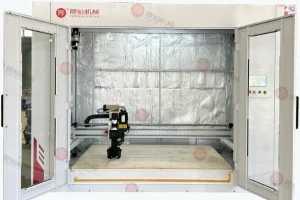
The DF2030 pellet 3D printer has a working stroke of 2000 × 3000 × 1200 mm, three heating sections, a maximum heating temperature of 350°C, and selectable nozzle diameters from 2 to 6 mm. It uses automatic feeding, servo drives, ball-screw transmission, and a fully enclosed metal cover. An optional drying system is also listed.
These specifications support large molds, tooling, patterns, and sculptures, but the drying option should be matched to the planned material list. A factory that prints mainly one stable resin has different needs from a service bureau that changes between PA, PC, ABS, and reinforced compounds every week.
Larger Nozzles Need Consistent Material Flow
A 6 mm nozzle can deposit material quickly, but high flow magnifies feed variation. If wet pellets cause intermittent foaming, the surface defect becomes larger too. A 2 mm nozzle produces a finer bead, yet it may be less forgiving of contaminants or unevenly melted particles.
Nozzle selection should be tested with the actual dried material, target layer height, and required machining allowance.
Three Heating Sections Cannot Correct Wet Feedstock
Multiple heating zones help build a controlled melt profile. They do not act as a full pellet dryer. Material may pass through the barrel too quickly for internal moisture to leave safely.
The optional drying system should therefore be treated as part of process planning, especially for moisture-sensitive or frequently changed materials. Heating the barrel more aggressively is not a reliable fix. It may increase degradation instead.
Printing and CNC Finishing Should Be Planned Together
Large printed molds are often produced near net shape, then milled to reach the final surface. Dry material supports denser walls, steadier machining, and fewer hidden voids.
CHENcan has worked with CNC equipment since 1998 and developed an industrial-scale printing and milling system in 2018. Its knowledge base also records in-house structural-part production, two production and research bases, ISO 9001 and CE certification, and dedicated additive-manufacturing patents for granular thermoplastic extrusion.
Buyers can review the company’s industrial manufacturing solutions and ask for a material and workpiece trial before confirming the equipment. The supplied knowledge base states that customers may provide drawings for factory proofing, which gives both sides a chance to check print quality and machine performance before an order.

What Should Buyers Ask before Ordering?
Material preparation should be discussed during equipment selection, not after installation. A useful supplier discussion should cover:
- Exact pellet grades and fiber content
- Maximum permitted moisture
- Local humidity
- Daily material consumption
- Dryer and hopper capacity
- Material change frequency
- Recycled material percentage
- Required mold strength
- CNC finishing allowance
- Quality records needed for each batch
The CHENcan service team provides installation, operation training, maintenance training, programming, repair, and technical troubleshooting. For a drying-sensitive process, training should include material storage, dryer operation, feeder cleaning, startup purging, and material-change procedures.
Drawings, pellet data sheets, expected output, and workshop conditions can be submitted through the contact page. Real material information produces a better machine and drying proposal than a request that only says “plastic mold printer.”
FAQ
Q1: Does every pellet need drying before 3D printing?
A: No. Drying needs depend on the exact resin, filler, storage history, and supplier instructions. Moisture-sensitive materials need tighter control, while every batch should still be checked for contamination or surface moisture.
Q2: Can wet pellets reduce the strength of a printed mold?
A: Yes. Moisture may create voids, weaken layer contact, and cause hydrolysis in sensitive polymers during hot extrusion. These effects may reduce strength even when the print looks complete.
Q3: What surface defects suggest that pellets are wet?
A: Common signs include popping sounds, bubbles, pinholes, rough beads, inconsistent width, silver-looking marks, and sudden changes in extrusion flow.
Q4: Does a heated extruder dry the pellets automatically?
A: No. The residence time inside the extruder is usually too short for controlled drying. Wet material may turn into vapor or degrade before it leaves the nozzle.
Q5: Is a drying system available for the DF2030?
A: Yes. The DF2030 product specification lists an optional drying system. The final configuration should match the selected materials, factory humidity, output rate, and material storage method.


