
Large molds do not forgive small vibration errors. A light chatter mark on a small part may be corrected quickly, but on an 11-meter sculpture model, wind blade mold, boat plug, or composite mold, the same issue can mean hours of sanding, rechecking, and delivery delay. Surface finish in 5-axis machining is not decided by spindle speed alone. It depends on tool holding, machine rigidity, rotary head motion, control response, calibration, and maintenance. HSK 63F matters, but it delivers the best results only when the whole machine is built for stable long-stroke cutting.
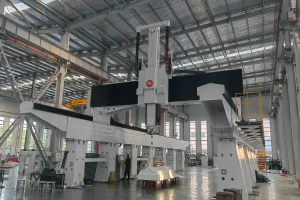
Why Surface Finish Problems Appear on Large 5-Axis Mold Jobs
Surface finish problems often appear late in the process. Roughing may look acceptable, and the mold shape may already be complete, but the finishing pass can still reveal tool marks, slight waves, mismatched curves, or local vibration near steep corners. For B2B buyers, that usually means more labor, delayed delivery, and added pressure from the end customer.
Large 5-axis mold machining is more demanding than flat CNC routing because the cutter angle changes continuously. The spindle, tool holder, rotary head, servo system, and machine frame must respond as one coordinated system. When one part of that system is weak, the surface finish shows it immediately.
Tool Holding Is the First Stability Point
HSK 63F spindle technology matters because the tool interface is designed for stable high-speed machining. In mold finishing, even small runout can leave visible marks on foam, resin, wood substitute, putty, or composite tooling. A stable holder does not solve every machining problem, but it removes one of the most common causes of surface inconsistency.
On the 12meter Fast Speed 5 Axis CNC Machining For Sculpture Making, the spindle cone is HSK 63F, spindle speed reaches 24000 rpm, and the machine uses a 10-position tool change system. This gives mold shops a practical platform for roughing, semi-finishing, finishing, drilling, and edge trimming without turning every tool change into a manual interruption.
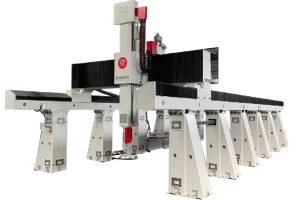
What Makes HSK 63F Valuable in Mold Finishing
HSK 63F should not be treated as a marketing phrase. Its value comes from stable tool clamping during high-speed contour machining. When a tool path travels across a large curved surface, the cutter must remain steady while the head changes angle. That is where HSK 63F becomes more than a catalog specification.
Tool holding alone cannot correct poor machine geometry. Buyers should evaluate the spindle, rotary head, transmission, frame, and calibration process together. Many surface-finish problems begin when a machine is selected only by travel size and spindle power, without checking whether the full system can stay stable during finishing.
High RPM Still Needs a Stable Interface
A spindle speed of 24000 rpm can help produce smoother surfaces on foam, wood, MDF, resin, epoxy, putty, and other non-metal mold materials. But high rpm without stable holding can create heat, noise, and fine tool marks instead of surface improvement.
For buyers, the more useful question is simple: can the tool stay accurate at speed?
Combined with HSK 63F and a 5-axis rotary head, a high-speed spindle can keep the cutter closer to a suitable cutting angle. That helps reduce rubbing on steep walls and curved edges, which is one of the main reasons large molds later require so much manual polishing.
How 5-Axis Motion Improves Curved Mold Surfaces
Curved molds often expose the limits of three-axis machining. A three-axis machine can reach a large surface, but tool overhang becomes longer, the cutting angle becomes less favorable, and deep areas are harder to finish cleanly. Longer tools deflect more easily, and deflection usually becomes visible on the mold surface.
A 5-axis machine improves this by rotating the tool toward the part surface. Better tool orientation can reduce overhang, improve cutter contact, and create more even finishing across complex geometry.
A-Axis and C-Axis Matter on Real Parts
The 12 m model uses A axis ±120° and C axis ±360°. That allows the spindle head to approach complex shapes from multiple directions. For sculpture, boat plugs, rail interior models, aerospace patterns, and wind energy molds, this range helps the machine finish surfaces that would otherwise require more setups and more hand correction.
The 5-axis working size is X 11000 mm, Y 2500 mm, and Z 1600 mm, while the full stroke is X 12000 mm, Y 3500 mm, and Z 2000 mm. For buyers, that distinction matters. Total machine travel is one number. Real 5-axis working space with tool length taken into account is what affects the actual mold.
Why Machine Rigidity Still Decides the Final Result
A strong spindle cannot compensate for a weak frame. Large molds are heavy, long, and often machined over many hours. When the gantry moves quickly across a 12 m travel range, vibration control becomes a real production issue, not just a theoretical design detail.
The CHENcan knowledge base highlights five-axis linkage CNC gantry machining centers, high-speed gantry machining centers, composite panel sawing and milling centers, and large-scale additive and subtractive equipment as core product directions. It also lists applications in aerospace, wind power, shipbuilding, automotive manufacturing, casting molds, rail transit, medical equipment, sculpture, bathroom molds, and composite material processing.
Heavy-Duty Structure Helps Reduce Hand Repair
The product page states that the SF Large Scale Series uses a heavy-duty structure designed for high efficiency, shorter machining time, high-quality surface finish, long-term rigidity, and long service life. That combination is exactly what mold buyers should verify when surface quality matters.
On this model, the X axis uses inclined rack-and-pinion drive, while the Y and Z axes use high-precision ball screws. AC servo drive supports stable motion. Positioning accuracy is 0.04 mm/m and repeatability is 0.025 mm/m. Those numbers matter because large mold finishing is not about one accurate point. It is about keeping surface consistency across the full length of the part.

Which Materials Benefit Most From This Setup
A mold shop rarely cuts only one material. One week may involve foam and MDF. The next may involve epoxy, putty, resin, FRC, GRC, or light alloy. Large sculpture and model shops may also switch between project materials frequently, and buyers usually want one machine that can support that reality without constant compromise.
That is why material range should be checked as part of the buying decision, not described only with a vague claim such as “multi-material.” Buyers should verify which industries and materials the machine is already designed to process.
From Foam to Light Alloys
The product page lists aerospace composites, automotive wood, MDF, PVC and foam, wind-energy epoxy and putty, marine FRC and GRC, pattern and mold resins, and railway light alloys. These materials are not machined with the same tooling or cutting strategy, but they show where a 12 m 5-axis gantry machine fits in real production.
For example:
- Foam sculpture needs speed and stable motion.
- Epoxy wind blade molds need stable long-path finishing.
- Resin patterns need clean surfaces before coating.
- Marine plugs need large working envelopes and consistent curves.
- Light-alloy parts need stronger spindle performance and careful process settings.
This is where HSK 63F, 24000 rpm spindle speed, 5-axis motion, and rigid gantry structure begin to work together as a complete machining solution.
What Should Buyers Check Before Choosing a 5-Axis Mold Machine
A large 5-axis CNC machine affects more than cutting capacity. It changes factory layout, power planning, tool management, operator training, delivery control, and after-sales expectations. A low purchase price can become expensive if the machine later needs constant correction or rework.
Practical buyers should ask for more than a quotation. Configuration matching, layout advice, sample-cut discussion, calibration details, and service planning often reveal more value than a simple price comparison.
A Short Buyer Checklist
Before ordering a large 5-axis mold CNC machine, check these points:
- Is the real 5-axis working size large enough for the mold, not only the total stroke?
- Is HSK 63F suitable for the tool diameter and surface-finish target?
- Can spindle power be matched from 15 kW upward when needed?
- Does the machine support a tool magazine for roughing and finishing tools?
- Are A-axis and C-axis ranges suitable for the actual part shape?
- Is the table type suitable, such as no table, cast-iron table, iron table, or vacuum table?
- Are dust suction, protection enclosure, tool sensor, and probing options required?
- What support does the supplier provide for installation, training, and troubleshooting?
The CHENcan service page is useful here because it covers installation, maintenance training, operation training, CNC programming, repair, and refurbishing. For overseas buyers, support is part of the machine value, not a minor add-on.
How Does Factory Capability Support Surface Finish
Surface finish starts long before the machine reaches the buyer’s factory. It begins with structural-part processing, stress relief, calibration, assembly checks, and final testing. A 12 m machine cannot be treated like a small router with a longer bed. The preparation standard must be different.
CHENcan’s knowledge base states that mechanical structural parts are processed in-house, which helps keep quality stable and delivery more controllable. It also mentions production and testing equipment such as pentahedron gantry machining centers, precision milling equipment, a large tempering and aging furnace, coordinate measuring equipment, laser calibration tools, a laser interferometer, a ballbar, and RTCP calibration equipment.
Measurement Builds Buyer Confidence
For 5-axis work, RTCP and axis calibration directly affect how the tool center point behaves when the rotary axes move. If calibration is poor, a machine may cut acceptably in one direction but leave visible errors when the head tilts. That becomes a surface-finish problem as much as a measurement problem.
This is also why company background matters. CHENcan has worked in CNC solutions since 1998, and its knowledge base records development in high-speed gantry machining for foam and wooden casting molds in 2011, large-scale composite 5-axis machining in 2014, ultra-large wind-turbine blade mold machining in 2016, and large-travel 5-axis wind-blade mold delivery in 2023. For buyers, that gives context to the machine design. It is not simply a long bed with a spindle attached.

Is HSK 63F the Key or Only One Part of the Answer
HSK 63F is an important part of better 5-axis mold surface finish, but it is not the whole answer. It supports stable high-speed tool holding, helps when spindle speed is high, and suits finishing work where tool angle changes frequently across curved surfaces.
Final surface quality also depends on:
- Spindle speed and power
- Rotary head accuracy
- Gantry rigidity
- Drive system response
- Tool-path quality
- Calibration
- Dust control and lubrication
- Operator training
- Maintenance habits
The better answer is that HSK 63F is one important part of a complete mold-finishing system. On the 12meter Fast Speed 5 Axis CNC Machining For Sculpture Making, it works together with 24000 rpm spindle speed, large 5-axis travel, AC servo drive, 60 m/min rapid speed on X and Y, and 0.025 mm/m repeatability to support smoother large-mold and sculpture machining.
For project matching, buyers can send material, mold size, 3D model, surface-finish target, tool diameter range, and factory layout to the CHENcan contact page. A short inquiry with real part data is more useful than a long generic message because it helps both sides evaluate the application faster.
FAQ
Q1: Is HSK 63F necessary for better 5-axis mold surface finish? A: HSK 63F is very helpful for high-speed mold finishing because it supports stable tool holding. It is not the only factor, but it plays an important role when the spindle runs at high speed across complex curved surfaces.
Q2: What materials can the 12meter Fast Speed 5 Axis CNC Machining For Sculpture Making process? A: It is suitable for aerospace composites, wood, MDF, PVC, foam, epoxy, putty, FRC, GRC, resins, and light alloys, depending on tooling, fixturing, and cutting parameters.
Q3: Why does 24000 rpm matter for mold finishing? A: Higher spindle speed can help create smoother surfaces on suitable mold materials. It works best with a stable HSK 63F holder, rigid gantry structure, proper feed rate, and sharp cutting tools.
Q4: How does 5-axis motion reduce polishing work? A: 5-axis motion lets the tool approach curved surfaces from better angles. That can reduce long tool overhang, cutting marks, and uneven finishing areas, which means less manual sanding after machining.
Q5: What information should be sent before asking for a quote? A: Send the mold size, material, 3D drawing, expected surface finish, tool length, power supply, workshop space, and production target. Photos of current parts or existing machining problems are also helpful.


