RV sandwich panels combine skins, adhesive, and a lightweight core, so they do not respond to machining like a solid board. When a factory uses the wrong tool, unstable vacuum, or aggressive cutting parameters, the result can be top-skin chipping, crushed core material, breakout on the back face, and sealing trouble around windows, doors, vents, and service openings. For manufacturers, poor cuts on RV sandwich panels quickly turn into scrap, rework, slower assembly, and higher warranty risk.
The best way to cut RV sandwich panels is to match the process, tooling, vacuum holding, and dust control to the real panel structure. CHENcan supplies sawing and milling solutions for RV bodies, refrigerated vehicle bodies, specialty vehicles, and construction panels, and its machining projects have reached buyers in more than 70 countries and regions.
What Causes Delamination and Edge Damage in RV Panels?
Delamination usually starts when cutting force, heat, spindle speed, feed rate, workholding, and chip removal do not match the real panel build-up. Because RV sandwich panels combine layers with different stiffness and density, the cutter can pull one layer away from another even when the top surface still looks acceptable.
Layered Materials Do Not Cut Like Solid Boards
A solid sheet has fairly consistent density from top to bottom. RV sandwich panels do not. The cutter may pass from a hard skin into a soft foam or honeycomb core and then back into another dense skin, so tool load changes quickly across one path.
Typical defects include:
- Top-skin chipping
- Core tearing
- Bottom-skin breakout
- Adhesive-line separation
- Crushed or uneven edges
A clean top face does not prove the part is sound. Buyers should inspect both faces, the exposed core, and the bond line after trial cutting to confirm that hidden damage is not developing inside the stack.
Panel Movement Turns Small Errors into Scrap
Large wall and roof parts are thin compared with their overall length, so weak or uneven suction can let the sheet lift slightly during routing. That movement changes cutting depth and edge pressure, which is why RV sandwich panels often show rough perimeters, oversized openings, or poor fit in final assembly when workholding is unstable.
Dust buildup can make the problem worse by reducing vacuum contact or creating a local high point under the sheet.
Which Cutting Method Gives the Best Edge Quality?
There is no single best process for every panel build-up. The correct method depends on skin material, core structure, adhesive system, thickness, and finish target. Some RV sandwich panels route cleanly, while others need sawing or a hybrid process to control edge damage.
Choose Routing, Sawing, or a Hybrid Process
Routing works well for contours, holes, pockets, and grooves. Sawing may reduce tearing on thicker layered structures or long straight cuts. A hybrid setup is often the safest option when RV sandwich panels need several operations in one flow.
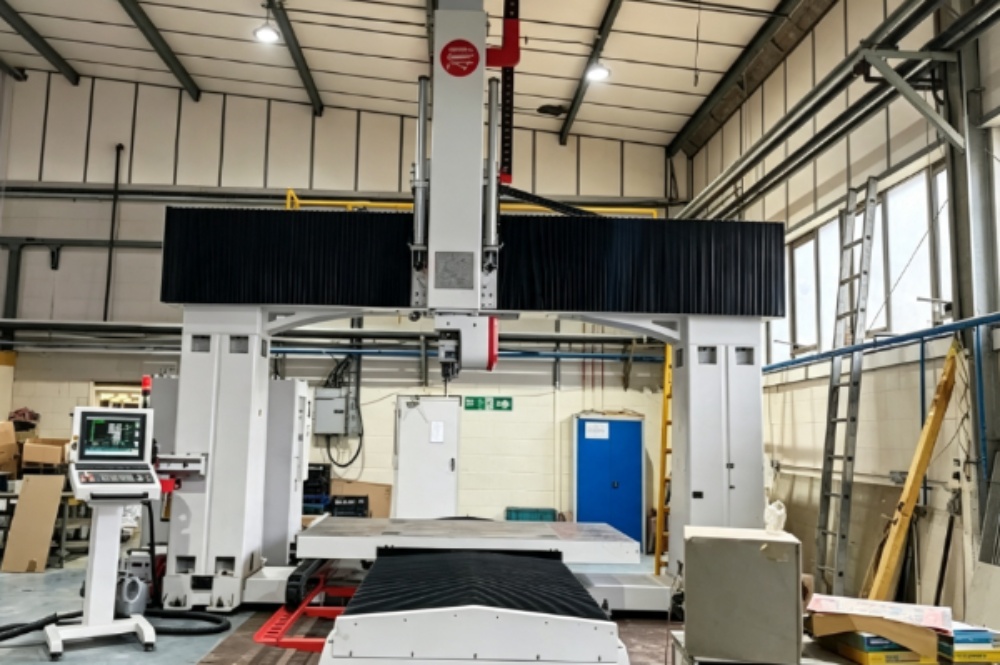
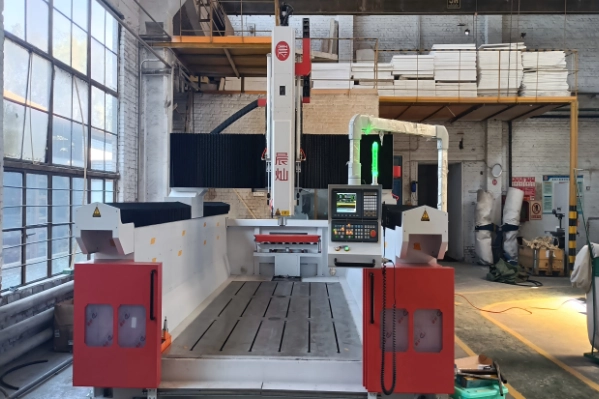
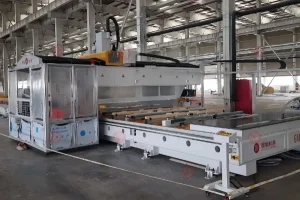
The GM3010AH Composite Board Processing Center for Camping Car Making is designed for sandwich panels below 170 mm thick and can be equipped with an optional cutting saw. That flexibility matters because some panel stacks carry a higher delamination risk if they are routed only.
Set the Process with a Real Panel Sample
Two materials sold under a similar commercial name may still use different skins, core densities, and adhesive recipes. Tool choice for RV sandwich panels should therefore come from a real cutting test, not from a catalogue description alone.
A useful test should compare cutter geometry, spindle speed, feed rate, depth of cut, and dust extraction. Lower feed is not automatically safer. Moving too slowly can build heat, while pushing too fast can increase cutting force and edge breakout.
How Does the GM3010AH Control Cutting Risk?
The GM3010AH uses a 3000 × 10000 mm table and a 3000 × 10000 × 350 mm working area, so it is sized for long vehicle panels and full body-side work. Its structure, motion system, and workholding design are built around the stability demands of RV sandwich panels.
Rigid Motion Helps Limit Vibration
The machine body uses thick-walled square-tube welding. The X and Y axes use high-speed rack-and-pinion transmission, the Z axis uses a precision ball screw, and square linear guides support smooth travel during long paths and corner transitions.
Rapid speed reaches 60 m/min on X and Y, while listed working speed reaches 35 m/min. Stable motion around window openings, roof cutouts, and tight corners helps keep the programmed path consistent instead of forcing operators to repair the edges later.
The Hollow Vacuum Table Handles Holding and Waste
Four 5.5 kW vacuum pumps support large, thin, or easy-to-deform parts. The hollow table also gives dust and chips a direct route into the collection area below, which is especially useful when cutting RV sandwich panels that generate mixed skin and core waste.
Better suction and cleaner support reduce sheet movement, waste buildup, and manual cleanup. In production terms, that means more repeatable edge quality over a full shift.
Automatic Tool Change Supports Multi-Step Work
The machine uses a 9 kW automatic-tool-change spindle rated at 24,000 rpm together with an eight-position carousel magazine. Separate tools can handle drilling, routing, grooving, openings, and finishing without repeated manual changeover.
Optional items include longer tables, a T-slot vacuum table, dust collection, vision cameras, and four-axis or five-axis saw configurations. Buyers can review these options through CHENcan’s composite panel processing solutions.
What Should B2B Buyers Confirm Before Ordering?
A specification sheet helps only when it matches the actual panel and production target. Buyers should provide samples, material build-up, drawings, maximum size, required tolerance, shift plan, and target cycle time so the technical team can confirm the right process for RV sandwich panels.
Use Trial Processing to Verify the Result
CHENcan offers workpiece trial processing before final machine selection. A good sample should include a long perimeter, tight corners, drilling, openings, grooves, and any feature that regularly causes edge damage. The knowledge base records more than 100 trial-processing services and over 1,000 process solutions in a year.
Inspection should cover:
- Chipping on both skins
- Core tearing or crushing
- Bond-line separation
- Hole size and position
- Edge squareness
- Cycle time and cleaning time
A machine may cut cleanly in one short demo and still slow the line if operators must stop often to clean the table, adjust suction, or sort damaged parts.
Check Factory Control and Service Capacity
CHENcan reports in-house processing of structural parts, dedicated R&D staff, ISO 9001 quality management certification, CE certification, and precision inspection equipment. Its knowledge base also records the development of a combined sawing and milling center for large composite sandwich panels in 2016.
Before shipment, each GM3010AH receives a 24-hour continuous movement test. The product carries an 18-month warranty and lifetime CNC service support, with installation, training, programming, troubleshooting, and repair services available.
How Can RV Factories Build a More Stable Cutting Process?
Consistent edge quality comes from process control rather than one impressive machine parameter. To machine RV sandwich panels well, the factory needs secure holding, stable motion, the right cutter or saw, effective dust removal, and a repeatable method from the first panel to the last.
The practical route is straightforward: send a representative sample, provide production drawings, request a timed trial, and inspect both visible and hidden edges. The GM3010AH gives manufacturers a dedicated platform for RV sandwich panels, and project details can be reviewed through the CHENcan contact team.
FAQ
Q1: Can a Standard CNC Router Cut Every RV Sandwich Panel?
A: No. Some RV sandwich panels can be routed cleanly, while others need sawing or a hybrid sawing and milling process to reduce delamination and edge damage.
Q2: What Panel Thickness Can the GM3010AH Process?
A: The GM series is designed for sandwich panels below 170 mm thick. Final tool and saw selection should still match the exact skin, core, and adhesive structure.
Q3: Why Is a Hollow Vacuum Table Useful?
A: It holds large, thin panels with strong suction and gives dust and chips a route into the collection area below, reducing sheet movement and waste buildup.
Q4: Should Buyers Request a Cutting Test Before Ordering?
A: Yes. A test with actual panels and production drawings can confirm edge quality, hole accuracy, cycle time, tool choice, vacuum holding, and dust handling before purchase.
Q5: What Support Is Available After Delivery?
A: CHENcan provides installation and training support, an 18-month warranty for this product, lifetime technical support, remote troubleshooting, maintenance guidance, and repair services.