A plastic job walks into any CNC shop looking like it should be easy, and then it stops the machine down for a week. The part is soft, the cut is fast, the material costs nothing, and then the surface comes out with a smear of transferred plastic on it, or the thin wall flexes under the clamp and the whole batch is out of dimension. Metal cutting taught shops to chase rigidity and low feed, and that instinct is exactly backwards here. Choosing a CNC plastic machine means buying for a different physics, not a cheaper version of the same spindle.
Most of the time the problem is not the machine being wrong, it is the spec being read like a metal spec sheet. A 10 kW spindle that pushes hard into steel will drag and melt into ABS. A rigid column that holds a heavy chip load in aluminum is the wrong rigidity for a 200 gram acrylic panel that needs to sit flat. What follows is the reading that actually applies to plastic: what the material does differently, what a proper machine has to offer because of it, and how the SF three axis and PC-A five axis families in the CHENcan line split the plastic work between them.
Why the Metal Spec Sheet Misleads Plastic Buyers
The first divergence is heat. Plastic conducts a fraction of what metal does, so the heat a cut generates does not leave through the chip and the work the way it does in steel. It stays at the tool tip, and the tool tip is what melts into the surface. The cure is not more power, it is speed with light engagement: a high rpm spindle, small diameter tools, and feeds that remove material before the heat builds. A proper CNC plastic machine is specified around that, not around a big slow cut that spends the whole job fighting a smear a metal shop would never see.
The second is deformation, and it is the one that quietly kills batches. Plastic is soft enough that the clamp pressure ignored in a steel block bends a thin wall, or the cutting force pushes the part off its fixture by a few thousandths. The fix is holding, not stiffness: a table that distributes pressure evenly across the part, which in practice means vacuum adsorption or a T-slot bed with the part supported along its whole back, not at three points. This is a fixture decision more than a machine decision, but the machine has to offer the platform for it.
The third is the chip itself. Long plastic ribbon does not fall away the way a metal chip does, and on a large panel it wraps the tool and the work. Dust removal and chip management are part of the machine for plastic in a way they are not for a small metal block. CHENcan runs this from the start on its non metal machines, which is why the range is specified as non metal rather than repurposed metal equipment.
What a CNC Plastic Machine Should Actually Offer
Three capabilities do most of the work.
Spindle character. The plastic answer is high speed at moderate power, not high power at low speed. The SF series runs 5.5 to 11 kW spindles on BT40 or BT50 tooling, and the PC-A carries a 6 kW, 18000 rpm high speed spindle with ER32 and a 20 mm maximum tool, which is the class of head that finishes acrylic and composites cleanly instead of dragging them. For how to size that spindle across foam, resin and FRP work, see how much spindle power large foam and resin molds need.
A flat, evenly held table. The SF3015 through SF5030 range steps from a 3000 by 1500 mm table up to 5000 by 3000 mm, all on three axis ball screw drives with a 40 m/min rapid, and all of them take a tool magazine as an option. The size steps are where most of the money is saved, because the wrong table forces a part to be cut in two and joined.
Protection and air. Plastic dust is finer and more conductive than wood dust, and it finds every electrical cabinet. The PC-A runs a gantry integrated cabinet that does not touch the floor plus full three axis protection, which keeps the electronics out of the dust cloud. That is a reliability decision, not a cosmetic one.
How the SF and PC-A Families Split the Plastic Work
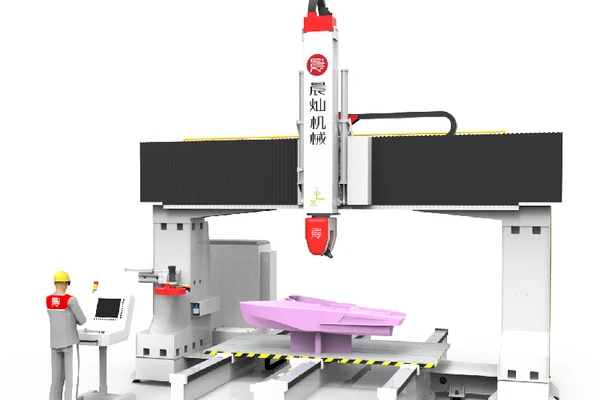
The clean way to think about it is that the SF is the production plastic machine and the PC-A is the contoured one. The SF is a high speed wood and non metal mold processing center, and for the flat and simple profile plastic work that fills most shops, panels, frames, enclosures, and the large format parts a three axis cut does in a day, it is the right and cheaper machine. Three axis, ball screws, a 20 m/min cutting speed, and a table sized to the part. It does not need a fifth axis, and paying for one it will not use is the most common waste in a plastic shop. How a CNC plastic machine choice breaks down is mostly flat versus contoured.
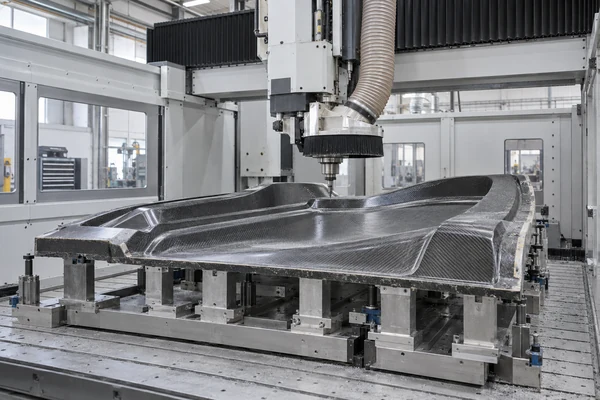
The PC-A fixed beam five axis center takes the plastic work that has depth. A cavity with an undercut, an enclosure whose walls slope, a composite or ABS part that needs a continuous contour across two axes. Its material list is built around the non metal shelf, carbon fiber, fiberglass, ABS, PMI, PET, EPS foam, aramid honeycomb, and general plastic, and its A and C axes at plus minus 120 and 360 degrees with 60 seconds of arc are what keep that contour in one setup. The buying framework for a shop deciding between the two is in which five axis router helps pattern and mold factories balance speed, accuracy and budget.
Where to land on the range, in one pass. Small to medium flat parts, high volume, one or two materials, stay on the SF3015 or SF3020. Parts that approach the edge of that table, or that mix large foam and hard plastic on the same bed, move to the SF5025 or SF5030. The moment the part is contoured rather than flat, the PC-A is the machine, and its four table sizes from 1600 by 2200 up to 1600 by 3000 mm cover the full thermoforming and composite tooling range. The full SF parameters are on the high speed mold CNC machine page, and the PC-A on the five axis CNC center page.
When Printing Replaces the Plastic Cut
For a low run plastic part, the fastest answer is often not a machine at all but a printed blank. CHENcan’s large format industrial 3D printers are FDM pellet machines, and they take exactly the thermoplastics a plastic shop works in, PP, PE, PS, nylon, PVC, ABS, PA, PPS and acrylic, to print a near net shape blank that the CNC then trues. The decision line between printing the blank and cutting the full block is drawn in when mold makers should use a large format 3D printer instead of CNC machining.
Even in that loop the CNC stays in, because the print is a blank and the contact and mounting surfaces still get machined to the tolerance the assembly needs. That pairing is also the cheapest way to test a part. Print a dozen, machine the contact faces, run the assembly, and only then commit to a machined block if the part survives. For a prototype that workflow replaces a week of tooling with a weekend of print time, and the machine that finishes the blank is the same plastic CNC you are evaluating. What to look for on the machine itself is covered in what makes a CNC machine truly industrial grade.
Conclusion
Choosing a CNC plastic machine is not buying a cheaper metal machine, it is buying for a different physics. The material does not conduct, it deforms under the clamp, and it sheds a chip that has to be managed, so the right machine gives you high speed at moderate power, a table that holds the part flat, and the protection to keep the dust out of the drives. The SF series covers the flat high volume work, the PC-A covers the contoured and composite work, and the two sit in the same building on the same workflow. The pre-purchase checklist that applies to both is in what to verify before buying a mould making machine, and the problems a fast head actually clears are in what mold making problems a high speed CNC router can solve. Send the part drawing and the material, and the choice usually answers itself.
Frequently Asked Questions
Q1: Can I run my metal CNC on plastic work?
Yes for a while, and that is exactly the problem. A metal machine will cut plastic, but it is tuned for stiffness and heavy feed, so thin walls flex and the surface smears under the drag a high speed head would not produce. If plastic is more than a side job, the mismatch shows up in scrap and rework long before it shows up in the machine price.
Q2: What materials does the CHENcan non metal range cover?
The PC-A application list covers ABS, PMI, PET, EPS foam, carbon fiber, fiberglass, aramid honeycomb and general purpose plastic, and the SF series is specified for wood and non metal mold work across the same plastic and composite shelf. The 3D printer side adds the thermoplastic pellets, PP, PE, PS, nylon, PVC, ABS, PA, PPS and acrylic, for parts that print rather than cut.
Q3: Do I need five axes for plastic parts?
Only if the part is contoured. Flat panels, frames and enclosures are three axis work, and the SF is built for exactly that, so a five axis price on a flat part is paying for axes the job never uses. The PC-A earns its five axes on undercuts, sloped walls and continuous composite contours that would need a second setup on a three axis machine.
Q4: How do I stop thin plastic from warping under the clamp?
Even pressure, not more of it. Support the part across its whole back with a vacuum adsorption platform or a T-slot bed rather than clamping at three points, and keep the clamp force at the lowest level that holds. The PC-A carries aluminum T-slot, phenolic resin and aluminum adsorption platforms with a vacuum distributor as part of the machine, which is the setup built for this.