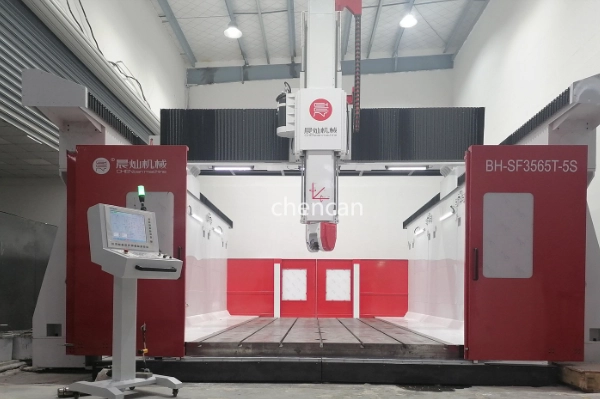
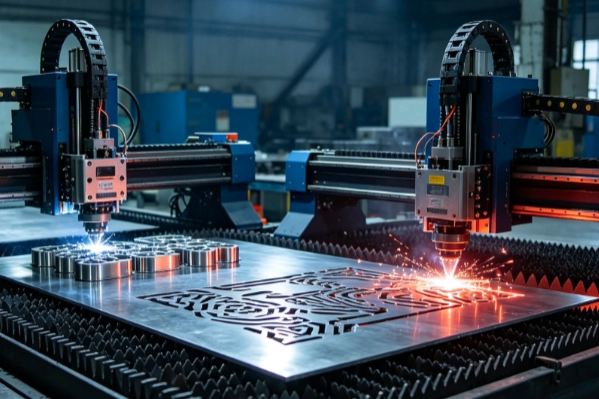
Oversized sandwich panels are difficult to machine for one simple reason: once the sheet is lifted and repositioned, the original datum is harder to recover accurately. In truck body, RV body, cold-chain box, and composite panel production, even a small shift can create door openings that need correction, uneven edge gaps, extra sanding, and avoidable rework.
That is why an extended bed CNC cutting machine is more than a larger table size on a quotation. It is a way to keep a full panel in one setup from the first trim to the last slot. For manufacturers evaluating full-size panel processing, the real issue is whether the machine structure, holding method, and motion stability can protect accuracy across the whole sheet.
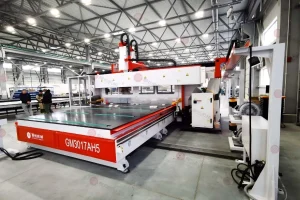
Why Does Repositioning Hurt Oversized Panel Production?
In small-format routing, moving a workpiece between operations may be manageable. In oversized sandwich panel cutting, the risk is much higher. A full truck side wall, roof panel, or refrigerated body board can include trimming, window openings, door cutouts, slots, holes, and assembly reference points that all need to stay aligned with one another.
Reference Errors Build Fast
Large sandwich panels often look rigid, but in practice they can be long, wide, and slightly flexible. The skin and core may also react differently during machining. If the operator cuts one area, pauses, shifts the panel, and sets a new origin, the second setup can introduce a small location error that carries through the rest of the part.
That error can show up as:
- window openings that need hand correction • joining points that no longer match cleanly • uneven edges after assembly • higher scrap risk on expensive composite panels • slower downstream fitting and sealing
A few millimeters may not sound serious during a quotation review, but on a truck body line they can quickly turn into fitting delays and repeat work for the assembly team.
Labor Saving Is Only Part of the Story
Many buyers first assume that an extended bed machine mainly saves labor. It does help reduce handling, but the larger value is geometric stability. When the whole panel is processed in one setup, edges, openings, and mounting features stay under one coordinate system instead of being rebuilt after every move.
For factories producing repeated truck body panels, that stability matters every day. One misaligned panel is frustrating. A batch of panels with the same alignment issue becomes a production problem that affects fitting, sealing, and delivery pace.
How Does an Extended Bed Keep Full Panels in One Setup?
An extended bed CNC cutting machine works well only when the longer table is backed by the right structure, support, vacuum layout, motion system, and process planning. Table length alone does not solve the problem. If the machine frame or holding method is weak, a long bed can simply introduce new accuracy risks.
Working Envelope Comes First
Buyers should check the effective machining area, not only the overall machine size. The practical question is simple: can the machine process the largest panel used in daily production without turning, sliding, or reclamping it halfway through the job?
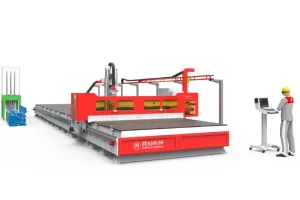
That is where the GM3015AH 3 Axis CNC Sandwich Panel Cutting Machine for Truck Body Manufacturing becomes relevant. It is positioned for full-size composite panel work where stable flat processing matters more than generic router labeling. The value is not just cutting capacity, but reducing repeated handling on long truck body panels.
Panel Support Must Match the Material
Sandwich panels are very different from solid metal blocks. They may combine FRP skins, foam cores, honeycomb structures, insulation layers, aluminum sheets, or other composite stacks. The support system has to keep the panel flat, hold it steadily, and avoid damaging the surface during machining.
A useful large-format setup should consider:
- vacuum zoning for large lightweight boards • stable support across the full table length • enough loading space for long panels • effective chip and dust collection • reliable reference stops or locating methods • sufficient clearance for panel thickness and tooling
This is often where low-cost quotations become weak. A supplier may offer a large table size, but if the holding method is unstable, the operator still ends up fighting the panel instead of machining it cleanly.
Which Machine Details Matter When Cutting Sandwich Panels?
Oversized panel processing is not only about X and Y travel. Cutting quality depends on how the entire machine behaves under load. The useful test is not a short dry run, but whether the machine can cut layered material across the full panel length repeatedly and still keep edge quality stable.
Spindle and Saw Logic for Layered Materials
A sandwich panel is a layered product, so one cutting method may not suit every feature. The outer skin may need a clean edge, while the core may need faster material removal. Truck body panels can also require straight trimming, slotting, drilling, and opening cuts in the same program.
تشينكان developed a large-scale saw-milling machining center for composite sandwich panel processing in 2016, combining milling and sawing in one process path for higher efficiency and precision. That background matters because panel cutting is often a mixed-process application rather than a single-tool job.
إن GM3015AH fits this practical requirement well: keep the panel fixed, complete the main cutting operations in one setup, and reduce manual secondary trimming wherever possible.
Motion Stability Across Long Travel
Long travel introduces another concern: can the gantry move across the full bed without vibration, deflection, or uneven cutting force? Industrial performance depends on the rails, drive system, gantry structure, servo response, and controller working together, not just on headline speed.
For long panels, buyers should ask:
- Is the bed structure processed for long-term stability? • Can the gantry resist deflection during cutting? • How is repeatability checked across the full stroke? • Does the machine keep edge quality from one end of the panel to the other? • Is the motion system tested under real cutting load, not only empty travel?
This is also why factory capability matters during supplier review. In-house processing of structural parts gives better control over frame quality, assembly consistency, and delivery timing, all of which matter more on large-format equipment than on small standard routers.
How Should Buyers Check Factory Strength Before Ordering?
For overseas buyers, the machine itself is only half the decision. The other half is whether the supplier can design, build, inspect, deliver, install, and support the system after it leaves the factory. A polished machine photo is easy to show. Stable production six months after installation is the harder test.
In-House Structural Processing
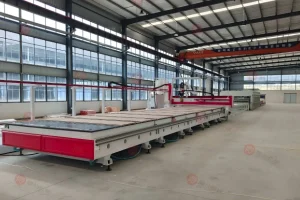
Large-format CNC equipment depends on a stable structure. CHENcan’s knowledge base shows that its mechanical structural parts are processed in house, with large gantry machining equipment, precision milling equipment, and tempering or aging furnaces used for structural work. That kind of setup gives buyers a better basis for trusting long-term frame stability.
The company also states that it has more than 60,000 square meters of production and research space, over 270 staff, and more than 10% of employees engaged in R&D, with customers in more than 70 countries and regions. These facts do not replace a technical review, but they do help buyers judge whether the supplier has enough depth for industrial panel projects.
Inspection, Certification, and Service
For a machine expected to cut oversized truck panels every day, inspection standards cannot be vague. CHENcan’s production bases hold ISO9001 and CE certification, and the company references tools such as coordinate measuring equipment, laser calibration equipment, laser interferometer systems, ballbar tools, and precision rotary calibration equipment.
A buyer should still ask for project-specific acceptance details:
- full-stroke accuracy verification • cutting sample plan • panel holding test • operator training scope • spare parts list • remote support method • on-site installation plan
It is better to review the service support process before the purchase order is signed, not after a problem appears on the shop floor.
Where Does the GM3015AH Fit in Truck Body Production?
Not every panel plant needs a complex five-axis solution. For many truck body panel applications, the main need is stable 3-axis cutting of full-size boards for trimming, contouring, window openings, door holes, slots, and repeated panel patterns. The real priority is one stable setup across the whole sheet.
Daily Workflow for Truck Body Panels
In a practical workflow, the operator loads the oversized sandwich panel, secures it, checks the reference, selects the program, and cuts the required features without shifting the board halfway through the process. The target is straightforward: fewer handling steps, fewer manual corrections, and better repeatability panel after panel.
The GM3015AH is a strong fit when the buyer wants a dedicated CNC platform for truck body sandwich panel processing rather than a general-purpose woodworking-style router. It supports a cleaner production flow for manufacturers that care about full-panel accuracy as much as cutting speed.
Buyer Checklist Before Purchase
Before choosing an extended bed machine, we suggest checking these points:
- maximum panel size used in real orders • largest cutting path, not only raw sheet size • panel thickness range and skin material • core behavior during cutting • vacuum or clamping plan • dust removal requirements • required edge finish • software workflow from drawing to machine • available floor space and loading path • installation, training, and after-sales response
If the factory already has drawings, send two or three representative panel files to the supplier. A simple rectangular panel does not reveal much. A side wall with windows, a door opening, and several assembly slots gives a much better basis for technical confirmation.
أسئلة متكررة
Q1: How can an extended bed CNC cutting machine reduce repositioning error? A: It keeps the full oversized sandwich panel fixed during machining, so openings, slots, and outer edges are processed under one coordinate system instead of being rebuilt after a second setup.
Q2: Is a 3 axis CNC machine enough for truck body sandwich panels? A: Yes, for many flat panel jobs such as trimming, contour cutting, window openings, door cutouts, and slotting. If the project needs bevels or complex angled features, a higher-axis solution may be required.
Q3: Why is vacuum zoning important for oversized sandwich panels? A: Vacuum zoning helps hold large lightweight panels flat during cutting and lets the operator apply holding force more precisely to different panel areas.
Q4: What should buyers check before ordering the GM3015AH? A: Buyers should confirm panel size, machining area, material layers, cutting features, holding method, dust removal, software workflow, installation support, and spare parts planning, ideally with a sample drawing review.
Q5: How can buyers contact CHENcan for a project review? A: Prepare panel drawings, material details, factory layout information, and expected production volume, then contact the CHENcan technical team for a more accurate machine recommendation.