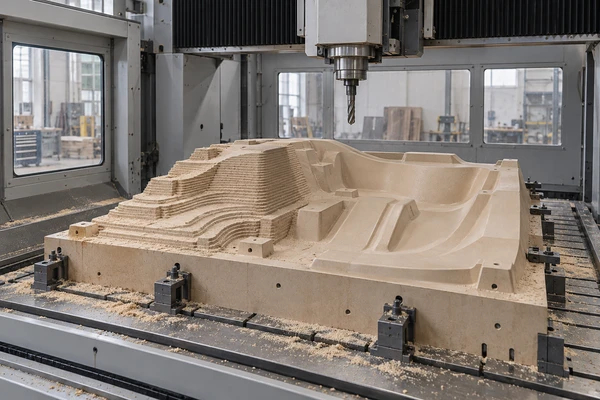
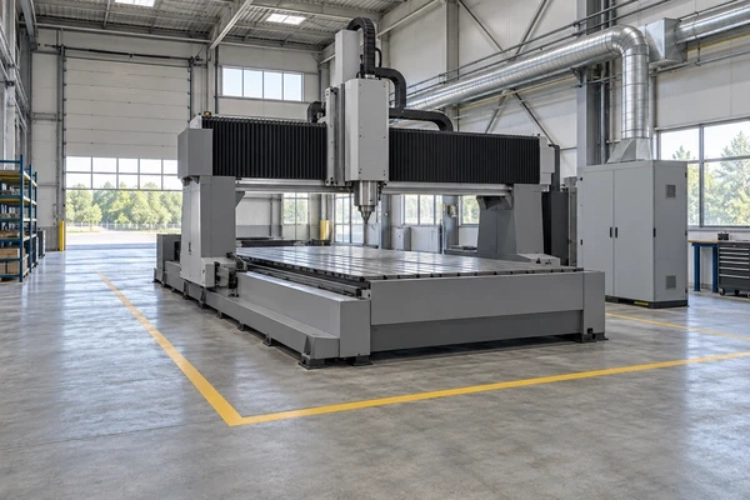
An industrial pellet 3D printer can be a better choice than machining a pattern from wood or tooling board when near-net-shape printing reduces material removal enough to justify the printing and finishing work. Large size alone is not sufficient. Compare material suitability, dimensional stability, final surface requirements, total lead time, and total cost for the same finished pattern.
El DF2016 Industrial 3D Printer Machines for Pattern Making can be evaluated for producing a printed blank before separate CNC finishing, sanding, or coating. Confirm the usable build envelope, qualified feedstock, bead size, and finishing requirements. Plan any milling on suitable downstream equipment rather than assuming the printer itself performs both operations.
This article focuses on reusable foundry patterns used to form a mold, rather than molds exposed directly to molten metal. Printing may be useful for large shapes that would otherwise require substantial machining or manual assembly. A design revision can be made in CAD, but reprinting and finishing still take time and must be compared with modifying the existing pattern.
Key Takeaways
Pellet printing is worth evaluating when a near-net-shape blank can reduce material removal and the required finishing capacity is available.
Select a suitable material and validate shrinkage, layer bonding, pattern durability, and the finished surface before choosing the process.
Compare the complete print-to-finish route with the existing method, including cooling, machining, coating, assembly, and inspection.
When Pellet Printing Is Worth Evaluating
Start with the pattern geometry and existing production route. Printing can be attractive when machining a solid blank would remove substantial material, or when a large shape can be built as a suitable shell with internal support. The printed structure must still provide enough wall thickness and stiffness for clamping, milling, handling, and repeated pattern use.
Frequent design changes may strengthen the case, but do not automatically make printing faster. Compare the effort required to repair or modify an existing wooden pattern with preparing, printing, cooling, and finishing a replacement. A representative trial should establish whether the proposed route actually shortens delivery.
When Conventional CNC Pattern Making May Be Preferable
CNC machining may remain the simpler route when the pattern is small, the geometry is readily accessible, and a suitable blank is inexpensive. It may also be preferable when fine features, proven material durability, or limited finishing capacity make coarse-bead printing impractical. Evaluate the finished tool and its service conditions rather than comparing machine speeds alone.
Feedstock and Thermal Control Determine Print Reliability
Pellets enter a heated extrusion unit, where they are melted and deposited as a bead. Stable feeding, suitable drying where required, and controlled melt flow help maintain consistent bead dimensions. Follow the material supplier’s processing guidance; excessive moisture or unsuitable temperatures can cause defects or material degradation.
Layer bonding depends on the material and the thermal condition of the receiving surface. Nozzle temperature, deposition rate, layer time, ambient conditions, and cooling interact. Uneven shrinkage can curl corners or distort tall walls. Validate material, build orientation, and any segmentation strategy on representative geometry before committing to a full pattern.
Bead Size and Layer Direction Affect the Finished Pattern
A larger bead can increase deposition throughput but limits small features and surface detail. Printed material can also behave differently across and along layers. Plan the wall structure and build direction for handling loads, clamping, machining forces, and pattern use. Finishing can remove surface stock; it cannot reliably correct weak bonding or inadequate wall thickness.
Post Processing Turns a Printed Form into a Production Tool
Many large printed patterns need milling, sanding, sealing, or coating to reach the required dimensions and surface quality. Plan the sequence before printing, including cooling, datum establishment, fixturing, and access for finishing tools. These operations can account for a substantial share of the total production time.
Allow stock where milling or sanding will remove material, and account separately for coating thickness where it changes the final surface. Confirm the allowance through trials rather than applying one value to every geometry. Too little stock may leave uncut areas; excessive stock adds printing and machining time.
Where CHENcan Equipment Fits the Process
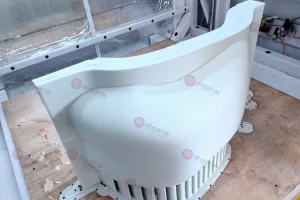
Discuss the complete pattern-making route with CHENcan, including both printing and any separate CNC finishing. Share the CAD model, pattern size, intended foundry use, candidate material, dimensional tolerances, and surface requirements. Identify how the printed blank will be located, supported, and transferred to the finishing equipment.
A successful project needs compatible printing software, a suitable printed structure, and a workable downstream process. CHENcan supports equipment installation, operator training, and ongoing technical assistance. Confirm the scope of material trials, finishing support, and acceptance testing for your project before ordering.
Compare Total Cost and Lead Time Before Choosing the Route
For the printing route, include file preparation, material drying, printing, cooling, support removal, assembly, CNC finishing, coating, and inspection. Add handling labor, waste, failed builds, and equipment occupancy. Compare these with blank preparation, programming, machining, assembly, and finishing in the current process.
Use the same finished dimensions, surface standard, and expected pattern life for both estimates. A short print time is not enough if cooling or finishing becomes the bottleneck. Likewise, reduced material removal is valuable only when the printed pattern meets its operating requirements at an acceptable total cost.
Validate the Pattern for Its Final Use
Inspect dimensions after cooling and again after machining and coating. For foundry use, also assess surface durability, release behavior, handling, and suitability for the intended molding process. Machine repeatability and nominal deposition rate do not establish finished-pattern accuracy or service life.
Before accepting the trial, confirm the following:
The final dimensions and surface finish meet the agreed requirements after all finishing operations.
The wall structure and layer direction withstand the planned handling, clamping, and use.
The complete process meets the target lead time and cost, with a repeatable inspection method.
Application Questions Before Trial Printing
Choose a trial that includes the actual pattern’s difficult features, such as corners, tall walls, joints, and critical surfaces. Define material, bead size, build orientation, finishing allowance, and acceptance criteria before printing. An attractive sample alone does not demonstrate production suitability.
For foundry patterns, check the parting arrangement, draft, required shrinkage allowance, and finished surface against the foundry’s requirements.
For segmented patterns, check joint alignment, bonding, assembly fixtures, and final dimensions.
For repeated use, evaluate wear, dimensional stability, handling loads, and repair requirements.
Record total lead time, material consumption, finishing labor, inspection results, and maintenance needs.
Pellet printing is a practical choice when the complete process delivers a suitable pattern at a better cost or lead time than the existing route. Review the CHENcan factory information and service pages to discuss manufacturing capabilities, installation, training, and project-specific support.
| Factor | CNC Pattern Making | Pellet Printing and Finishing | Decision check |
| Material use | Removal from a blank | Near-net-shape deposition | Compare total waste |
| Lead time | Prepare, machine, finish | Print, cool, machine, finish | Include every step |
| Acceptance | Final size and durability | Final size and durability | Use the same criteria |
Preguntas frecuentes
What is pellet 3D printing?
A: It melts suitable thermoplastic pellets and deposits the material layer by layer. For pattern making, the resulting blank may need separate machining and surface finishing before use.
When is pellet printing better than CNC pattern making?
A: It can be preferable when near-net-shape deposition reduces material removal and the full printing-and-finishing route meets the required quality, cost, and delivery targets. Verify this with a representative trial.
What affects layer strength in pellet printing?
A: Feedstock condition, melt temperature, receiving-layer temperature, deposition rate, layer time, and build direction all influence bonding. The acceptable settings depend on the material and geometry.
Does a printed pattern still need machining?
A: Often, yes. Large printed patterns commonly need milling, sanding, sealing, or coating. Define the final tolerance and surface requirements before deciding which operations are necessary.
What should a buyer share with CHENcan before selecting a printer?
A: Share the CAD model, pattern dimensions, intended use, candidate material, tolerances, surface finish, current production route, and target delivery time. Include the available finishing equipment and operator training needs.